
Rotary Actuator for Automation Equipment: Electric and Servo Options
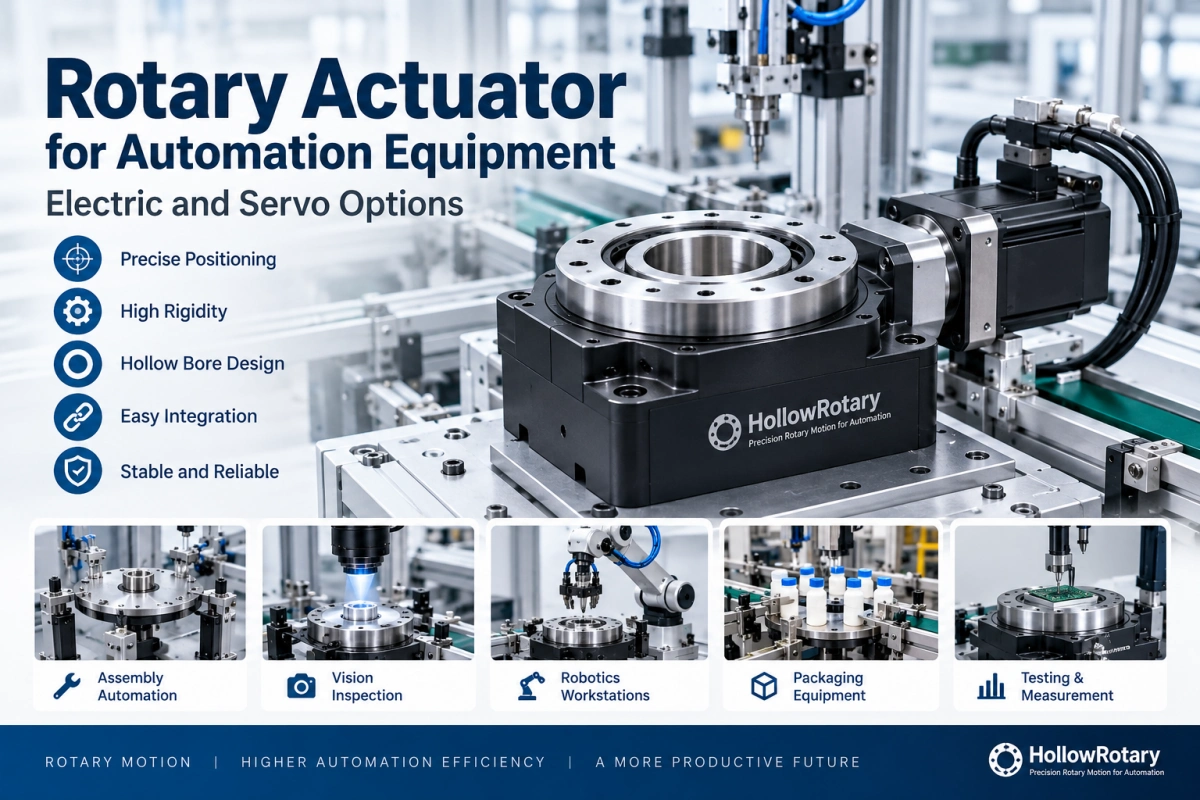
A rotary actuator is used when automation equipment needs controlled rotary motion instead of simple linear movement. It can rotate a fixture, workpiece, tooling plate, inspection part, or machine mechanism to a defined angle. In industrial automation, rotary actuators are commonly used for positioning, indexing, orientation, loading, inspection, assembly, testing, and robotic support.
For machine builders, choosing the right rotary actuator is not only about rotation angle. The real selection should consider load, torque, speed, repeatability, positioning accuracy, motor control, installation space, cable routing, and long-term production stability.
This guide explains how rotary actuators are used in automation equipment, how electric and servo rotary actuator options differ, and what buyers should check before choosing a rotary motion solution.
What Is a Rotary Actuator?
A rotary actuator is a mechanical motion component that converts input power into rotary movement. Unlike a linear actuator, which moves in a straight line, a rotary actuator creates angular motion around an axis. This motion may be limited to a certain angle, such as 90 or 180 degrees, or it may support continuous or programmable rotation depending on the design.
In automation equipment, a rotary actuator is usually used when a part needs to be turned, indexed, flipped, aligned, presented to a robot, or moved between workstations. It can be installed inside assembly machines, inspection systems, packaging equipment, electronic manufacturing machines, testing fixtures, and custom automation modules.
Different actuator types exist in the market, including pneumatic, hydraulic, electric, and servo-driven designs. For modern precision automation, electric rotary actuators and servo rotary actuators are often preferred because they provide better motion control, cleaner installation, and easier integration with programmable control systems.
Why Rotary Actuators Are Important in Automation Equipment
Many automation machines need repeated angular movement. A fixture may rotate from a loading position to an assembly position. A product may turn under a camera for inspection. A robotic station may use a rotary axis to present parts at different angles. A test system may need to rotate a component to several defined positions.
In these situations, a rotary actuator helps simplify the machine layout. Instead of using several complex mechanisms to create rotation, the machine can use one integrated rotary motion unit. This can reduce mechanical complexity, save installation space, and improve positioning consistency.
A good rotary actuator can also improve production stability. When the actuator provides repeatable motion, the fixture returns to the same position cycle after cycle. This is important for machines that operate continuously in production lines.
Electric Rotary Actuator vs Servo Rotary Actuator
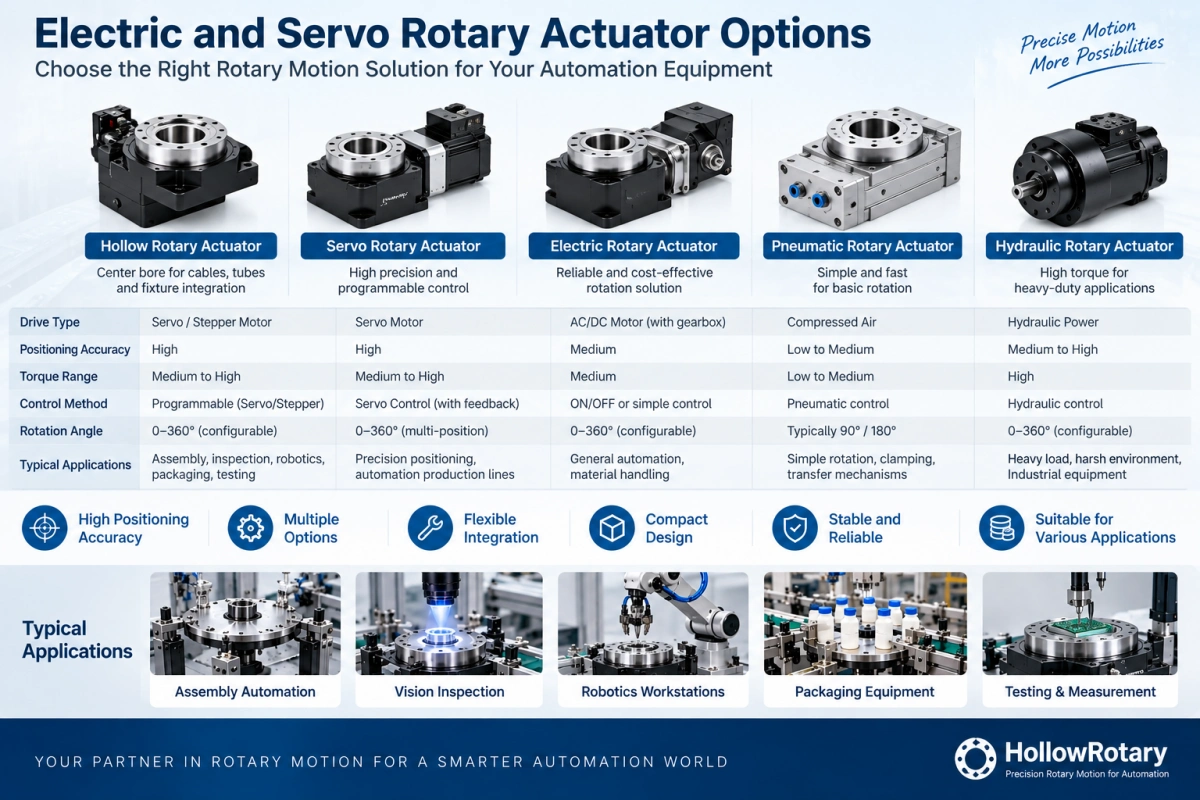
The terms electric rotary actuator and servo rotary actuator are sometimes used together, but they are not always exactly the same. An electric rotary actuator generally means a rotary actuator driven by an electric motor. A servo rotary actuator usually means the system uses a servo motor and control feedback for more accurate positioning and programmable motion.
For basic automation tasks, a motorized rotary actuator may be enough if the movement is simple and the accuracy requirement is not very high. For more demanding machines, a servo rotary actuator may be a better choice because it can provide controlled speed, acceleration, stopping position, and repeatable angular movement.
| Item | Electric Rotary Actuator | Servo Rotary Actuator |
|---|---|---|
| Control Type | Basic electric rotation or motor-driven movement. | Programmable servo control with position feedback. |
| Positioning | Suitable for simple or moderate positioning needs. | Better for accurate and repeatable positioning. |
| Application | General machine movement, turning, orientation. | Inspection, assembly, robotics, testing, precision automation. |
| Selection Focus | Torque, angle, speed, size, installation. | Accuracy, repeatability, load, inertia, motor matching, control system. |
Common Rotary Actuator Applications
Rotary actuators can be used in many industrial automation systems. The best design depends on the required motion, load condition, positioning accuracy, and machine layout.
1. Assembly Automation
In automated assembly machines, a rotary actuator may move a fixture between loading, pressing, fastening, inspection, and unloading positions. Stable rotary motion helps keep the workpiece aligned with tools, sensors, or robots.
2. Vision Inspection Equipment
Inspection systems often need to rotate parts under cameras, lights, or sensors. A servo rotary actuator can help position the part at a consistent angle, improving inspection repeatability and reducing image position variation.
3. Robotic Workstations
A rotary actuator can act as an auxiliary axis in a robotic cell. It can rotate a workpiece to a better pickup angle, improve robot access, or reduce robot path complexity. This is useful in loading, assembly, inspection, and handling applications.
4. Packaging and Orientation Systems
Packaging machines may use rotary motion for product orientation, labeling, transfer, sorting, and positioning. A compact rotary actuator can help the machine complete repeated motion in a limited installation space.
5. Testing and Measurement Fixtures
Testing equipment may need to rotate a product to several fixed angles. Repeatable rotary positioning helps create stable test conditions and improves measurement consistency.
Key Factors When Selecting a Rotary Actuator
1. Rotation Angle
The first question is how the actuator needs to move. Some machines need 90-degree or 180-degree movement. Others require continuous rotation or programmable positioning at multiple angles. The required angle range will affect the actuator type and control method.
2. Load and Fixture Weight
The actuator must support the fixture and workpiece safely. Buyers should provide fixture weight, workpiece weight, table diameter, load center distance, and installation direction. A small rotary actuator may work well under light load but become unstable when a heavy or offset fixture is installed.
3. Torque Requirement
Torque requirement depends on load, inertia, acceleration, speed, and motion cycle. A rotary actuator should not be selected only by static load. If the machine needs fast start and stop movement, dynamic torque becomes more important.
4. Positioning Accuracy and Repeatability
For simple motion, basic position accuracy may be acceptable. For inspection, assembly, testing, and robotic applications, repeatability is often more important. The actuator should return to the same position consistently across repeated cycles.
5. Speed and Cycle Time
Cycle time affects production efficiency. A rotary actuator must move fast enough for the process, but it also needs stable acceleration and deceleration. If the movement is too aggressive for the load, vibration, overshoot, or unstable stopping may occur.
6. Installation Space
Automation machines often have limited space. The actuator size, motor direction, cable outlet, fixture height, and surrounding mechanical structure should be considered before selection. A compact rotary actuator can help simplify the machine layout.
7. Cable and Air Tube Routing
Some automation systems need cables, air tubes, vacuum lines, or sensor wires to pass through the rotation center. In this case, a hollow rotary actuator or hollow rotary table may be more suitable than a solid-shaft rotary mechanism.
When to Choose a Hollow Rotary Actuator
A hollow rotary actuator is useful when the machine needs rotary motion and center access at the same time. The hollow bore allows cables, tubes, or fixtures to pass through the center, helping create a cleaner and more compact automation layout.
This design is commonly used in equipment where wiring and pneumatic routing are important. Instead of routing cables around the outside of the rotating mechanism, the machine builder can route them through the center bore. This helps reduce cable twisting, improves appearance, and makes maintenance easier.
For applications that need compact integration, stable fixture support, and controlled rotary motion, you can review our hollow rotary actuator product page. If your machine requires a table-style output platform, the hollow rotary table page may also be useful.
Rotary Actuator Selection Checklist
Before asking for a quotation, it is better to prepare clear application information. This helps the supplier recommend a suitable rotary actuator instead of guessing from only a model name or product photo.
- Application: assembly, inspection, packaging, robotics, testing, or custom automation.
- Rotation angle: 90 degrees, 180 degrees, 360 degrees, or multi-position movement.
- Load details: fixture weight, workpiece weight, diameter, height, and center of gravity.
- Required accuracy: positioning accuracy and repeatability requirement.
- Speed: rotation time, cycle time, and duty cycle.
- Motor control: servo motor, stepper motor, or other electric drive requirement.
- Installation space: available width, height, motor direction, and mounting method.
- Routing needs: cables, air tubes, vacuum lines, or sensor wires through the center bore.
Common Mistakes When Choosing a Rotary Actuator
One common mistake is selecting a rotary actuator only by outside size. Two actuators may look similar, but their load capacity, rigidity, positioning accuracy, and motor compatibility may be different.
Another mistake is ignoring fixture design. A heavy or unbalanced fixture can create moment load and inertia problems. Even if the actuator itself is accurate, the final machine may become unstable if the fixture is poorly designed.
A third mistake is treating all rotary actuators as the same. Pneumatic rotary actuators, hydraulic rotary actuators, electric rotary actuators, and servo rotary actuators are designed for different use cases. For precision automation, the control method and mechanical structure should match the real process requirement.
A fourth mistake is not considering future maintenance. Cable routing, motor access, mounting bolts, and fixture replacement should be planned before the machine is built. A good rotary actuator selection should make the machine easier to assemble, debug, and maintain.
FAQ
What is a rotary actuator used for?
A rotary actuator is used to create controlled angular motion. It can rotate fixtures, workpieces, tooling plates, or machine mechanisms in automation equipment.
What is the difference between an electric rotary actuator and a servo rotary actuator?
An electric rotary actuator is driven by an electric motor. A servo rotary actuator uses servo control for more accurate position, speed, and motion control.
When should I choose a hollow rotary actuator?
A hollow rotary actuator is suitable when the machine needs rotary positioning and center bore access for cables, air tubes, vacuum lines, or fixture wiring.
What information is needed to select a rotary actuator?
You should provide the load, fixture size, rotation angle, speed, cycle time, accuracy requirement, motor requirement, installation space, and cable routing needs.
Conclusion
A rotary actuator is an important motion component in modern automation equipment. It helps create controlled rotary movement for assembly, inspection, testing, packaging, robotics, and custom machine applications.
For precision automation, the actuator should be selected according to the complete machine requirement. Load, torque, speed, repeatability, positioning accuracy, installation space, motor control, fixture structure, and routing needs should all be reviewed together.
By choosing the right electric or servo rotary actuator, machine builders can improve equipment stability, simplify machine layout, and create more reliable rotary positioning performance.
Reference Notes
- A rotary actuator should be selected by real application data, not only by outside size.
- Electric and servo rotary actuators are often better suited for programmable automation than simple pneumatic rotary movement.
- Fixture weight, load center distance, speed, and repeatability can strongly affect final performance.
- Hollow rotary actuator designs are useful when center bore access is needed for cables, tubes, or fixture integration.
Need Help Selecting a Rotary Actuator?
Share your application details, including load, fixture size, rotation angle, speed, accuracy requirement, motor information, bore size requirement, and installation space. HollowRotary can help evaluate whether a hollow rotary actuator, hollow rotary table, servo rotary table, or rotary indexer is more suitable for your automation equipment.