
How Does a Hollow Rotary Actuator Work in Automation Equipment?
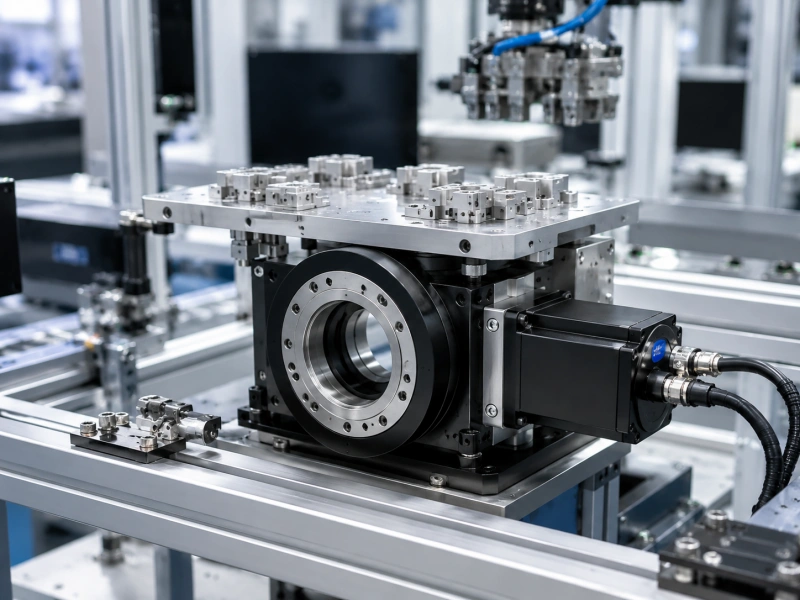
A hollow rotary actuator is a compact rotary positioning unit used in automation equipment where controlled rotation, fixture support, and a central hollow bore are required. It is commonly used in packaging machinery, assembly automation, inspection systems, electronic manufacturing equipment, and custom machine designs.
This article explains how a hollow rotary actuator works, why the hollow bore design matters, where it is used, and what information buyers should prepare before selecting a suitable model.
When engineers design an automated machine, rotary motion is often needed for indexing, fixture orientation, part transfer, inspection angle adjustment, or compact station layout. In many cases, a general motor and gearbox combination can rotate a load, but it may not provide the same integrated structure, mounting convenience, and center-through design as a hollow rotary actuator.
A hollow rotary actuator combines rotary transmission, bearing support, mounting structure, and output table interface into one compact unit. The hollow center allows cables, air tubes, vacuum lines, optical paths, or mechanical shafts to pass through the middle of the rotating system. This is why the product is widely used in automated machines that require both rotation and a clean internal routing path.
What Is a Hollow Rotary Actuator?
A hollow rotary actuator is a rotary positioning device designed to convert motor input into controlled angular output. Unlike a simple coupling or turntable, it usually includes an integrated reduction mechanism, high-rigidity bearing structure, and a table-style output flange. The output side can support a fixture, workpiece holder, small turntable, inspection platform, or tooling plate.
The word “hollow” refers to the central bore. This through-hole is one of the most important design features. In automation equipment, the center bore can be used for cable routing, pneumatic tubing, vacuum connection, sensor wiring, or other machine elements that should not be exposed outside the rotary unit.
In practical machine design, a hollow rotary actuator is not selected only by outside size. Engineers usually consider load condition, bore size, output flange diameter, allowable moment, positioning accuracy, repeatability, motor compatibility, installation direction, and available space inside the machine.
How Does a Hollow Rotary Actuator Work?
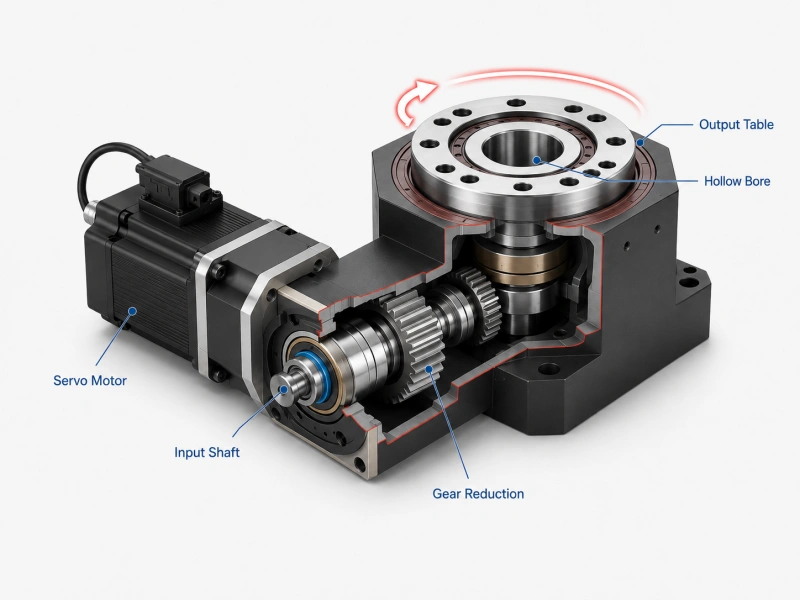
A hollow rotary actuator usually works together with a servo motor or stepper motor. The motor provides rotational input. Inside the actuator, the transmission structure reduces speed, increases torque, and delivers controlled rotation to the output table or flange. The machine controller then commands the motor to move to specific angles, speeds, or positions according to the production cycle.
In a servo-driven system, the controller can program different rotation angles, acceleration profiles, dwell time, and stop positions. This makes the actuator suitable for machines that require flexible positioning rather than only fixed mechanical indexing. For example, a packaging station may rotate a fixture by a defined angle, while an inspection machine may move a part to several viewing positions.
The actuator itself provides mechanical support. The output flange holds the fixture or tooling, while the internal bearing structure helps support radial load, axial load, and overturning moment within the product’s design limits. This integrated structure can reduce the number of separate parts needed in the machine design.
Selection should not be based only on motor power. The actuator must also match the load, fixture size, cycle time, positioning requirement, and installation space. If the load is offset from the center, moment load becomes especially important.
Why the Hollow Bore Design Matters
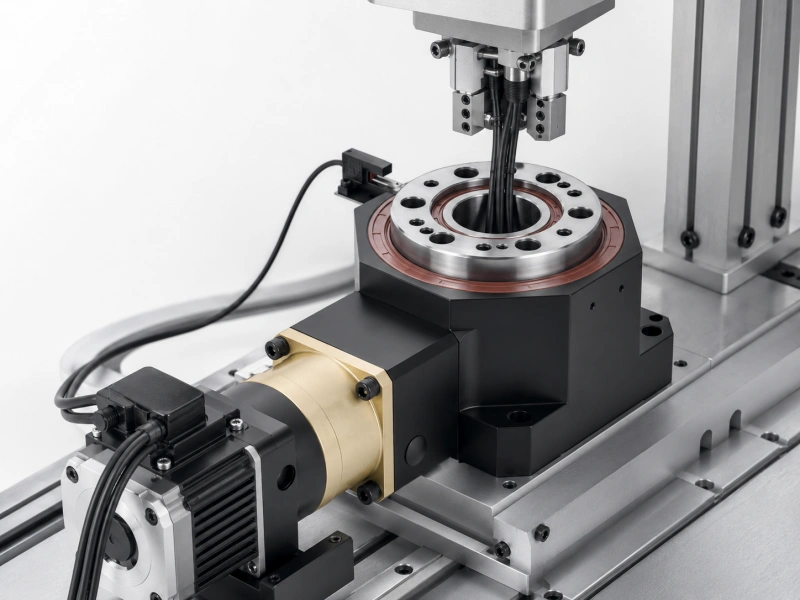
The hollow bore is one of the main reasons engineers choose this product instead of a standard motor and gearbox structure. In automation equipment, exposed cables and air tubes can create layout problems, safety concerns, and maintenance difficulties. A hollow center gives the designer a cleaner routing option.
For example, a rotary fixture may need sensor wiring, vacuum suction, pneumatic clamping, or electrical signals passing through the center. If these lines are routed outside the rotating unit, they may twist, interfere with nearby components, or require additional cable management devices. With a hollow rotary structure, the routing can be more compact and organized.
The hollow bore is also useful when the actuator is installed under a small table or fixture. The center can remain open for tooling access, inspection light path, air connection, or machine structure passing through the rotation axis.
When an automation system needs rotary positioning with a central through hole, buyers may compare different hollow rotary table product series based on table diameter, bore size, load capacity, ratio, and positioning accuracy.
Common Applications in Automation Equipment
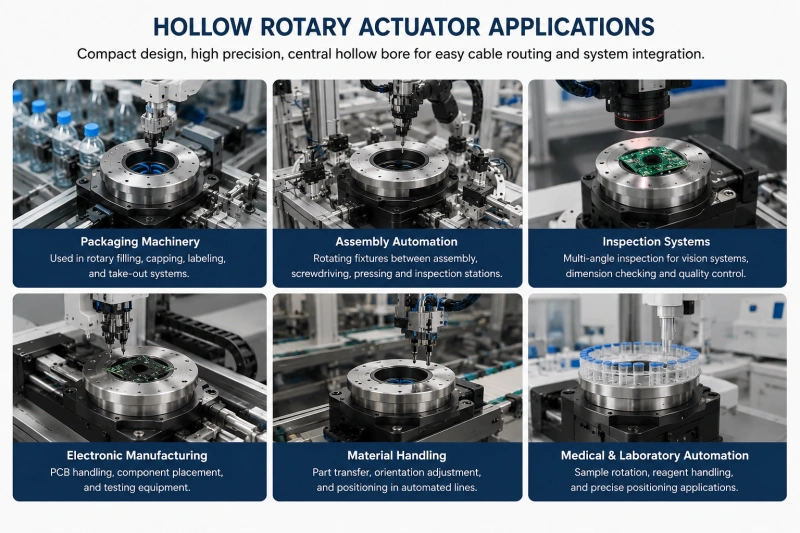
Hollow rotary actuators are used in many industrial automation machines. The exact application depends on the fixture design, load weight, cycle speed, and required positioning accuracy. In many projects, the actuator is selected because it can combine compact rotation, table support, and central routing in one unit.
If the machine uses multiple stations and needs repeated step-by-step transfer, a servo rotary indexer may also be considered. If the project mainly needs a table-style rotary support surface, a hollow rotary table may be more suitable. For broader use cases, you can review our rotary positioning applications page.
Hollow Rotary Actuator vs Hollow Rotary Table
Many buyers compare a hollow rotary actuator with a hollow rotary table. The two products are closely related, but the naming often depends on the structure, supplier, and application focus. In general, a hollow rotary actuator emphasizes the integrated motion unit and drive function, while a hollow rotary table emphasizes the output table, fixture support, and rotary platform function.
| Item | Hollow Rotary Actuator | Hollow Rotary Table |
|---|---|---|
| Main Focus | Integrated rotary motion unit with motor-driven positioning | Table-style rotary support for fixtures and workpieces |
| Typical Use | Compact automation modules, servo-driven rotation, custom equipment | Fixture rotation, inspection table, indexing surface, machine station layout |
| Selection Concern | Motor matching, torque, speed, positioning accuracy, bore size | Load capacity, table size, mounting surface, moment load, repeatability |
| Buyer Question | Can it provide the required motion and fit my servo or stepper motor? | Can it support my fixture and rotate accurately within the machine space? |
In real purchasing communication, the important point is not only the name. The supplier should understand the machine layout, motor requirement, load condition, fixture size, and expected movement. This is why a clear project description is more useful than only asking for a model number.
Key Selection Factors
To choose a suitable hollow rotary actuator, buyers should prepare basic technical information. This helps reduce wrong selection and speeds up quotation communication.
Installation space is also important. If the actuator must fit inside a compact machine base, the outside dimensions, bore size, mounting direction, and cable exit direction should be checked early. For OEM projects, drawings or machine layout images can help the supplier understand the real requirement faster.
When Should You Contact a Supplier?
You should contact a supplier when the product must match a specific machine structure, motor brand, fixture design, or operating cycle. Even if the product looks simple, the final choice often depends on several engineering conditions.
A good inquiry should include the application, load weight, fixture size, bore requirement, rotation angle, positioning accuracy, motor type, quantity, and target delivery time. If you are not sure which product direction is suitable, you can send your requirement first and ask the supplier to compare actuator, rotary table, indexer, or positioner options.
HollowRotary Automation supports product selection and quotation communication for rotary positioning products. You can review our rotary positioning products or contact our team with your project requirement.
Conclusion
A hollow rotary actuator works by converting servo or stepper motor input into controlled rotary output while providing fixture support and a central hollow bore for routing. It is useful in automation equipment where compact layout, repeatable positioning, and clean cable or air-line management are important.
For buyers, the best selection is not based only on product name or outside size. Load condition, rotation angle, accuracy, motor mounting, bore size, and installation space should all be considered. If the application involves fixture rotation, indexing, inspection, assembly, or compact machine design, a hollow rotary actuator can be an effective rotary positioning solution.
Need Help Selecting a Hollow Rotary Actuator?
Send us your application details, load condition, motor information, bore size, and installation space. We will help evaluate whether a hollow rotary actuator, hollow rotary table, servo rotary indexer, or other rotary positioning product is more suitable.
Send Your Requirement