
Hollow Rotary Table vs Hollow Rotary Actuator: How to Choose for Automation Equipment
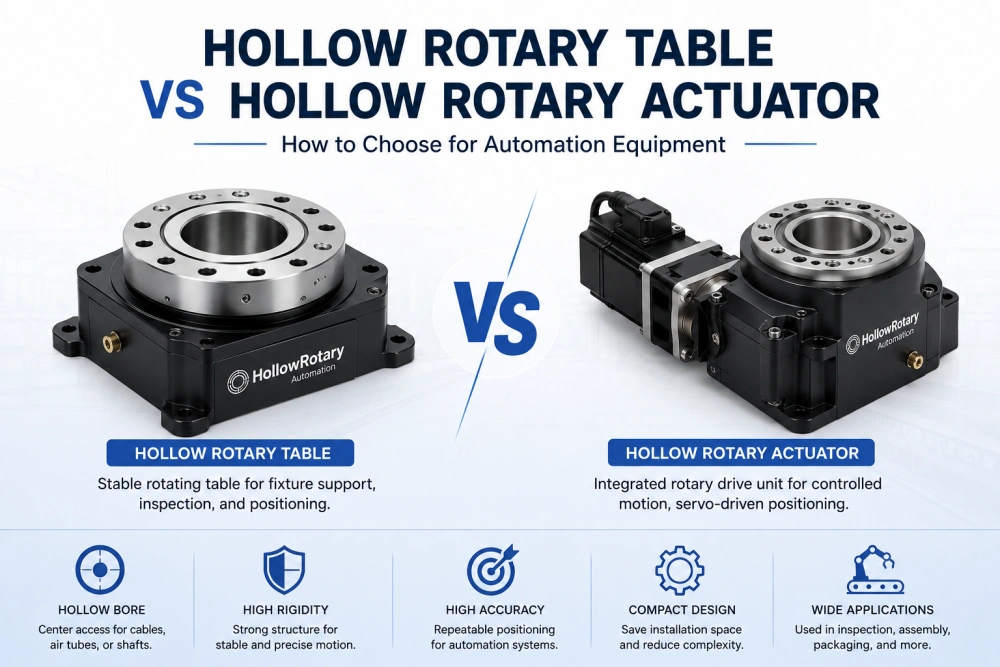
Many automation buyers compare a hollow rotary table and a hollow rotary actuator when designing compact rotary positioning systems. At first glance, the two products can look similar because both may have a central hollow bore, a rotating output surface, and mounting holes for fixtures. However, their application focus is not always the same.
This guide explains the practical differences between a hollow rotary table and a hollow rotary actuator, when each option is more suitable, and what technical information buyers should prepare before asking for a quotation.
In automation equipment, rotary motion is used for indexing, fixture rotation, part orientation, inspection alignment, loading and unloading, or multi-station production. A standard motor and gearbox can create rotation, but it may not provide a compact table structure, central bore access, or convenient fixture mounting. This is why many machine builders consider specialized rotary positioning products.
The key question is not only which product name is correct. The better question is: does your machine need a table-style rotating support surface, an integrated actuator structure, a specific motor mounting method, or a compact solution with center cable routing? The answer will help determine whether a hollow rotary table or a hollow rotary actuator is more suitable.
What Is a Hollow Rotary Table?
A hollow rotary table is a rotary positioning unit with a table-style output surface and a central through-hole. It is commonly used when the machine needs a stable rotating platform for fixtures, workpieces, inspection plates, or automation tooling. The table surface allows the user to mount a fixture directly on the rotating output.
In many projects, the hollow rotary table is selected because it provides a compact structure, high rigidity, repeatable positioning, and a clean center bore for cable, air tube, vacuum line, or mechanical access. Compared with building a rotary platform from separate bearings, couplings, plates, and transmission parts, a hollow rotary table can simplify the machine structure.
Typical applications include inspection tables, assembly stations, fixture orientation, compact indexing modules, electronic component handling, and automation equipment where the workpiece or tooling needs to rotate around a fixed center.
What Is a Hollow Rotary Actuator?
A hollow rotary actuator is also a rotary positioning unit, but the wording usually emphasizes the drive and actuation function. It is often used when engineers focus on controlled rotary movement from a servo motor or stepper motor to the output flange or table. In other words, the actuator is not only a support table; it is part of the motion system.
A hollow rotary actuator may include transmission, bearing support, motor mounting, output flange, and central hollow bore in one compact design. The motor provides input, the internal mechanism reduces speed and increases torque, and the output table rotates the fixture or machine component to the required angle.
In practical use, a hollow rotary actuator is suitable for compact automation modules, programmable rotary movement, servo-driven indexing, and applications where the machine needs both rotation and integrated drive support.
Main Differences Between Hollow Rotary Table and Hollow Rotary Actuator
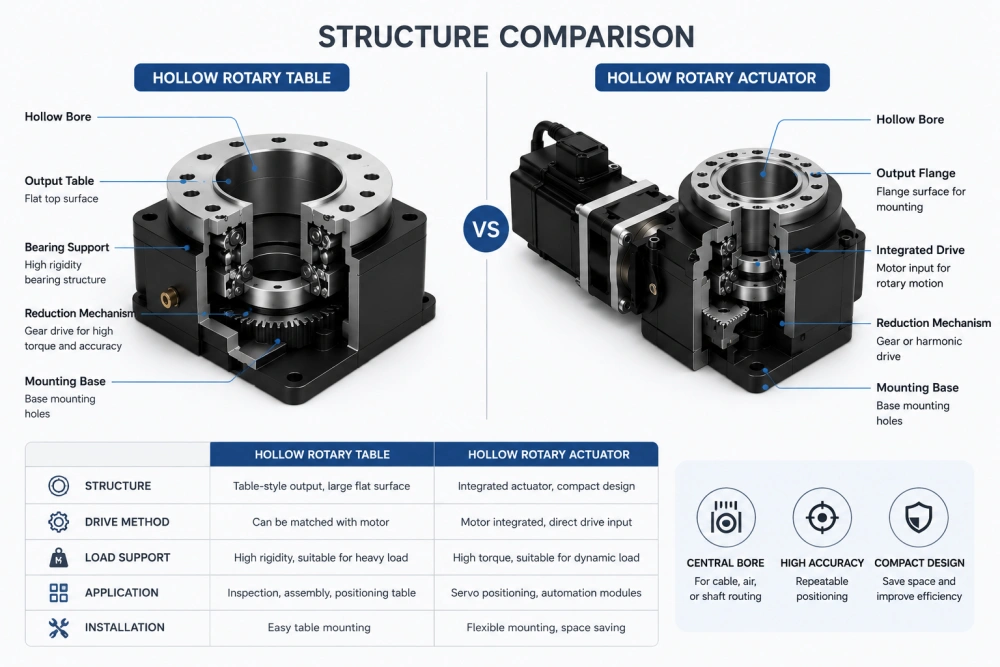
The terms are sometimes used differently by different suppliers. Some companies may call a product a hollow rotary table, while others may call a similar structure a hollow rotary actuator. For buyers, the practical comparison should focus on function, not only naming.
| Comparison Point | Hollow Rotary Table | Hollow Rotary Actuator |
|---|---|---|
| Main Focus | Table-style rotating surface for fixture support, part positioning, or inspection platforms. | Integrated rotary drive unit for controlled angular motion and servo-driven positioning. |
| Typical Buyer Need | “I need a compact rotary table to support and rotate a fixture.” | “I need a motor-driven rotary actuator for programmable positioning.” |
| Motor Relationship | May be used with servo or stepper motor depending on the structure and supplier configuration. | Usually discussed together with motor mounting, input shaft, drive direction, and motion control. |
| Selection Focus | Table size, load capacity, fixture diameter, moment load, bore size, repeatability, and mounting surface. | Motor type, torque, speed, gear reduction, output angle, cycle time, bore size, and installation space. |
| Common Applications | Inspection table, fixture rotation, assembly table, compact indexing surface, electronic handling. | Servo rotary modules, automated positioning stations, programmable indexing, custom motion units. |
In real purchasing communication, the name alone is not enough. A supplier should understand the load, fixture size, bore requirement, rotation angle, motor type, installation direction, and accuracy requirement before recommending a model.
When Should You Choose a Hollow Rotary Table?
A hollow rotary table is usually a good direction when the main requirement is fixture support and stable rotary positioning. If your machine has a workpiece holder, inspection plate, small turntable, or fixture that must rotate accurately, the table structure can provide a clear mounting surface.
If your project mainly requires a stable rotating platform, you can review our hollow rotary table product page for product direction and application reference.
When Should You Choose a Hollow Rotary Actuator?
A hollow rotary actuator is often a better direction when the project focuses on motor-driven motion and integrated actuation. If you already know the servo motor type, required rotation angle, speed, torque, and cycle time, the actuator selection may be more important than only the table surface.
The actuator direction is suitable for machine builders who need a compact rotary drive module instead of designing a full transmission structure from separate components. It can simplify motor input, reduction, bearing support, output rotation, and fixture mounting in one product direction.
If your machine needs a compact motor-driven rotary unit, you can compare details on our hollow rotary actuator page.
Application Selection Examples
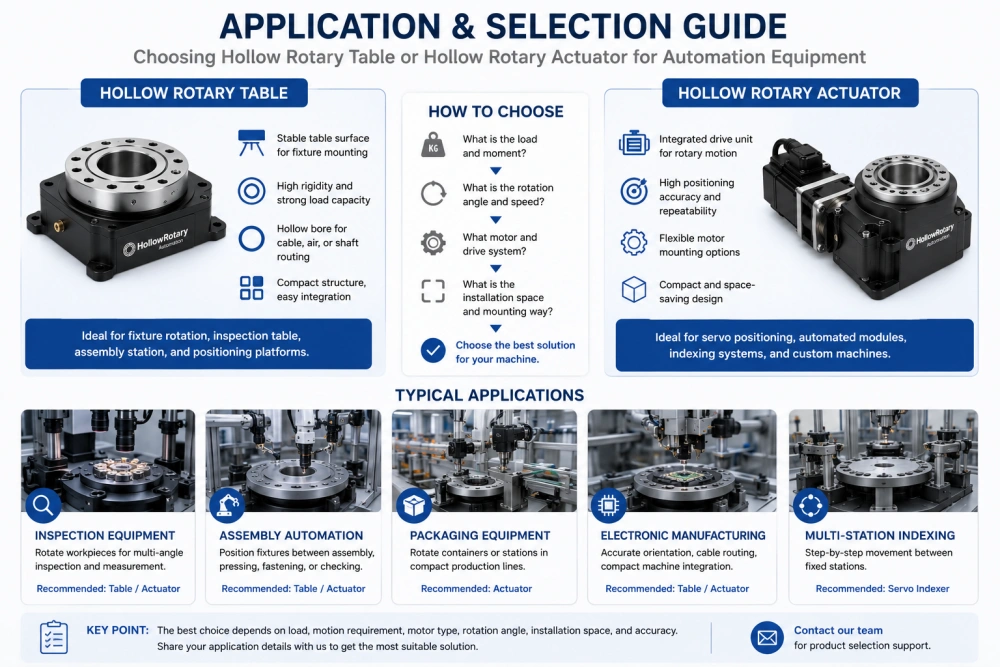
Different automation applications may use different rotary positioning products. The following examples show how buyers can think about product direction before asking for a quotation.
| Application | Common Requirement | Possible Product Direction |
|---|---|---|
| Vision inspection station | Rotate the part under a camera or sensor for multi-angle checking. | Hollow rotary table or hollow rotary actuator, depending on fixture size and motor control. |
| Assembly automation | Move a fixture between assembly, pressing, fastening, or checking positions. | Hollow rotary table for fixture support, or actuator for integrated servo-driven motion. |
| Packaging equipment | Rotate containers, tooling, or stations in a compact production line. | Hollow rotary actuator, servo rotary table, or servo rotary indexer depending on cycle type. |
| Electronic manufacturing | Accurate orientation, cable routing, and compact machine installation. | Hollow rotary table or actuator with suitable bore size and repeatability. |
| Multi-station indexing | Repeated step-by-step movement between fixed stations. | A servo rotary indexer may be more suitable. |
For more machine examples, you can also view our automation applications page.
Key Selection Factors Before Quotation
Whether you choose a hollow rotary table or a hollow rotary actuator, the supplier will need basic technical information before recommending a suitable model. Clear project details help reduce wrong selection and save communication time.
Accuracy and repeatability should also be considered. If the equipment involves camera inspection, precision assembly, electronic component handling, or synchronized production cycles, the positioning requirement should be explained clearly.
How to Avoid Wrong Selection
Wrong selection often happens when buyers only compare product appearance or model size. A hollow rotary table and a hollow rotary actuator may look similar in photos, but the internal structure, load capacity, motor interface, output support, and suitable application can be different.
To avoid wrong selection, prepare your application details before contacting a supplier. Even a simple machine sketch, fixture drawing, or photo of the installation area can help the supplier understand your real requirement. If you are not sure which product type is suitable, you can describe the process first instead of choosing a model directly.
HollowRotary Automation supports product selection for hollow rotary actuators, hollow rotary tables, servo rotary tables, servo rotary indexers, hollow rotary platforms, and servo rotary positioners. You can review our rotary positioning products or contact our team with your project information.
Conclusion
A hollow rotary table and a hollow rotary actuator are both useful rotary positioning products for automation equipment. The hollow rotary table is often selected when fixture support, table surface, center bore, and stable positioning are the main concerns. The hollow rotary actuator is often selected when the project focuses more on integrated motor-driven motion, programmable positioning, and compact actuator structure.
The best choice depends on the machine layout, load condition, motor type, rotation angle, bore requirement, accuracy, and installation space. Instead of choosing only by name, buyers should compare the actual function required by the machine.
Related Product Resource
If you are comparing hollow rotary tables and hollow rotary actuators for automation equipment, you can review Zhuochuang hollow rotary table models for different bore sizes, load capacities, accuracy requirements, and servo motor matching options.
For applications where load, indexing accuracy, cable routing, and installation space must be checked together, contact Zhuochuang for model selection support .
Not Sure Which Rotary Positioning Product to Choose?
Send us your application details, load condition, fixture size, motor information, bore requirement, and installation space. We will help evaluate whether a hollow rotary table, hollow rotary actuator, servo rotary table, or servo rotary indexer is more suitable.
Send Your Requirement