
What Is a Servo Rotary Indexer and Where Is It Used?
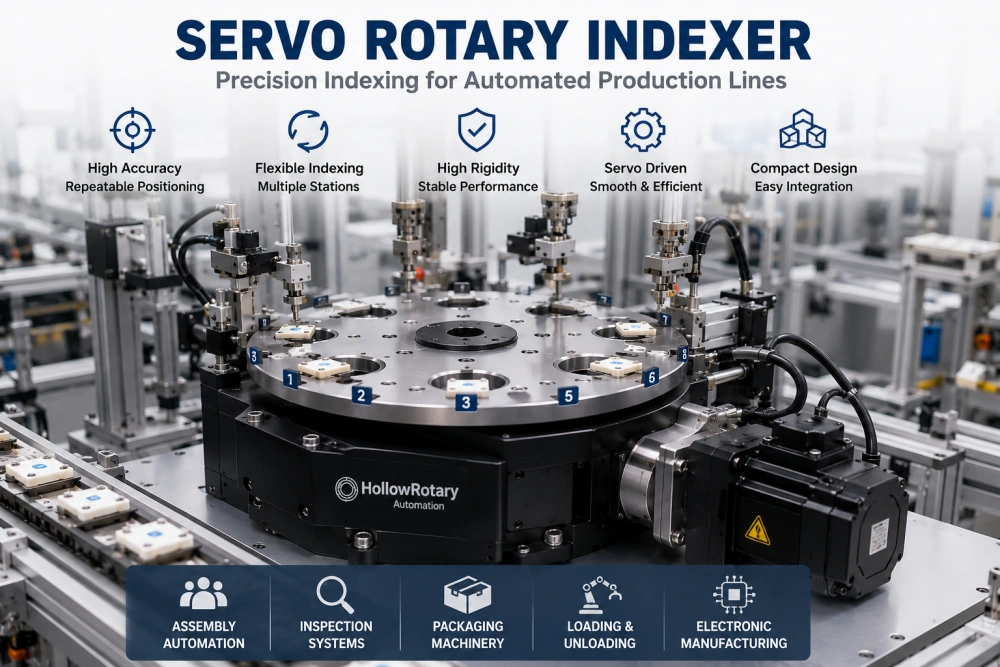
A servo rotary indexer is a rotary positioning device used in automation equipment to move fixtures, parts, or workstations from one position to another with controlled motion. It is commonly used in packaging machinery, assembly automation, inspection systems, electronic manufacturing equipment, loading and unloading stations, and custom production lines.
This guide explains what a servo rotary indexer is, how it works, where it is used, and what information buyers should prepare before selecting a suitable rotary indexing solution.
In automated machines, many processes require repeated movement between fixed or programmable positions. A workpiece may need to stop at one station for loading, another station for assembly, another for inspection, and another for unloading. In this type of machine layout, a servo rotary indexer can help create controlled rotary indexing motion.
Compared with a simple turntable or manual rotary fixture, a servo rotary indexer is designed for automated movement. It works with a servo motor and control system, allowing the machine to set rotation angle, speed, acceleration, dwell time, and stop position according to the production process.
What Is a Servo Rotary Indexer?
A servo rotary indexer is a motor-driven rotary positioning unit used to rotate a table, fixture, or workpiece between different angular positions. The word “servo” means that the movement is usually controlled by a servo motor and drive system. The word “indexer” means that the device is often used for indexing movement, where the output rotates to a defined position and stops accurately.
In practical automation equipment, a servo rotary indexer may be used as the central indexing unit of a multi-station machine. It can rotate a fixture plate step by step, move parts between processing stations, or position a workpiece under cameras, tools, dispensers, presses, screwdrivers, welding heads, or inspection devices.
The product direction is different from a general motor and gearbox combination. A servo rotary indexer is usually selected for complete rotary positioning performance, including output support, torque transmission, repeatability, installation convenience, and compatibility with the machine’s control process.
How Does a Servo Rotary Indexer Work?
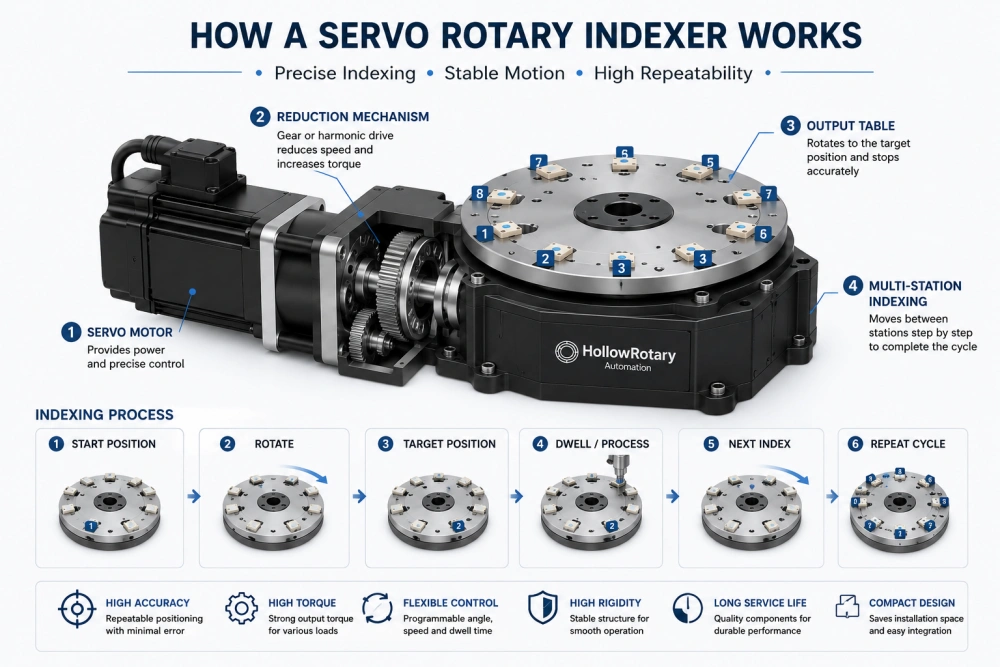
A servo rotary indexer works by receiving input from a servo motor and transferring that motion to an output table or rotary platform. The motor is controlled by the machine controller, which defines how far the indexer should rotate, how fast it should move, how long it should stop, and when the next movement should begin.
For example, in a four-station assembly machine, the indexer may rotate 90 degrees each cycle. In an inspection machine, it may rotate to several different viewing angles. In a packaging machine, it may move containers or fixtures through filling, capping, labeling, and unloading stations. The movement does not need to be the same for every project because servo control allows more flexible motion programming.
The output side of the indexer supports the fixture or table plate. The internal transmission and bearing structure help maintain positioning stability under load. When the indexer reaches the target position, the machine can perform the next process before the next indexing movement starts.
Selection should not be based only on outside size. The load, fixture diameter, indexing angle, cycle time, repeatability, motor configuration, and installation space all affect whether a servo rotary indexer is suitable.
Servo Rotary Indexer vs Hollow Rotary Table
Buyers sometimes compare a servo rotary indexer with a hollow rotary table. Both can be used for rotary positioning, but their application focus is different. A hollow rotary table is often selected when the main need is a compact table-style support surface with a central bore. A servo rotary indexer is often selected when the machine needs repeated indexing movement between stations.
| Comparison Point | Servo Rotary Indexer | Hollow Rotary Table |
|---|---|---|
| Main Function | Moves a fixture or table between defined indexing positions. | Provides a compact rotary table surface for positioning or fixture support. |
| Typical Use | Multi-station machines, indexing systems, assembly lines, packaging stations. | Inspection tables, fixture rotation, compact rotary platforms, part orientation. |
| Motion Control | Usually servo-driven and programmable for angle, speed, dwell time, and cycle process. | May be servo-driven, but the focus is often table support and compact rotary positioning. |
| Selection Focus | Indexing angle, station number, cycle time, load, repeatability, motor matching. | Table size, bore size, load support, moment load, mounting surface, repeatability. |
In some automation projects, a servo rotary indexer may also be compared with hollow rotary table solutions when the application requires a central through hole, cable routing, and compact rotary positioning.
If the machine only needs controlled rotation of a compact fixture, a servo rotary table may also be considered. If the machine requires a central bore and stable table support, a hollow rotary table may be suitable. If the machine requires station-by-station movement in a production cycle, the servo rotary indexer is often the better product direction.
Common Applications of Servo Rotary Indexers
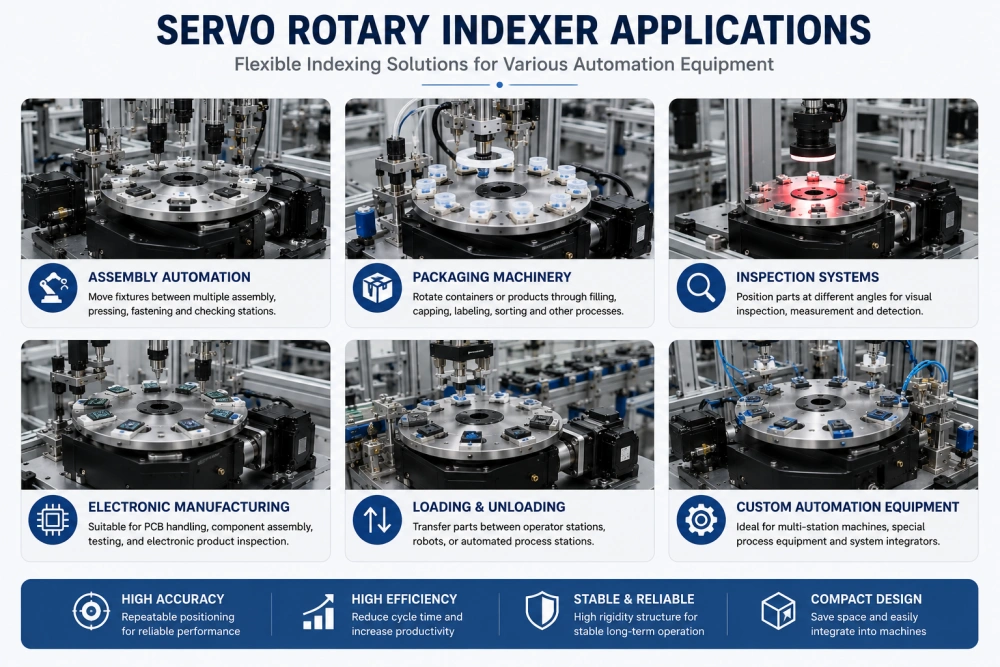
Servo rotary indexers are used in many automation systems where the process requires repeated positioning between different workstations. The machine may use one central rotary plate, several fixtures, or a custom tooling structure mounted on the indexer output.
For more application directions, you can review our automation applications page.
When Should You Use a Servo Rotary Indexer?
A servo rotary indexer is usually suitable when the machine needs repeated movement between several positions. If the process includes multiple stations and each station performs a different operation, indexing motion can make the machine layout compact and efficient.
It is also useful when the machine needs flexible position control. Compared with a fixed mechanical indexing solution, servo-driven indexing can be easier to adjust when the product, station angle, or process cycle changes. This can be important for OEM machines, custom automation projects, or equipment that must handle different product sizes.
However, a servo rotary indexer may not be necessary for every rotary motion application. If the project only needs simple fixture rotation or a compact table support surface, a hollow rotary table or servo rotary table may be enough. If the project needs a hollow center and compact integrated drive structure, a hollow rotary actuator may also be considered.
Key Selection Factors
Before selecting a servo rotary indexer, buyers should prepare clear technical information. This helps the supplier understand the machine process and recommend a suitable product direction.
What Information Should You Provide Before Quotation?
A clear inquiry helps reduce wrong selection and speeds up quotation communication. Instead of only asking for a price, it is better to provide the machine application and basic operating conditions.
| Information | Why It Matters |
|---|---|
| Application type | Helps identify whether the product is used for assembly, inspection, packaging, loading, or custom automation. |
| Number of stations | Determines indexing angle and motion cycle. |
| Load and fixture size | Affects torque, bearing support, output table size, and moment load. |
| Speed and cycle time | Helps evaluate acceleration, deceleration, motor matching, and production rhythm. |
| Accuracy and repeatability | Important for inspection, assembly, electronic manufacturing, and precise positioning. |
| Motor requirement | Useful for confirming servo motor mounting, input interface, and control direction. |
If you already have a drawing, machine layout, fixture image, or rough sketch, it can help the supplier understand the application faster. For custom automation projects, even a simple process description is useful.
Conclusion
A servo rotary indexer is a rotary positioning product used for controlled indexing movement in automation equipment. It is especially useful when a machine needs to move fixtures, parts, or workstations between defined positions in a repeatable production cycle.
The best choice depends on station number, indexing angle, load condition, fixture size, cycle time, accuracy requirement, motor configuration, and installation space. If your machine needs multi-station indexing, programmable rotary positioning, or compact automated transfer, a servo rotary indexer may be the right product direction.
Need Help Selecting a Servo Rotary Indexer?
Send us your application type, station number, indexing angle, load condition, fixture size, motor information, and installation space. We will help evaluate whether a servo rotary indexer, servo rotary table, hollow rotary table, or hollow rotary actuator is more suitable.
Send Your Requirement