
Rotary Indexing Table Selection Guide for Automation Equipment
A rotary indexing table is often used when an automation machine needs to move a fixture from one fixed station to the next. The movement looks simple from the outside, but the selection is not simple. Station count, load, fixture diameter, indexing angle, cycle time, accuracy, cable routing, and machine layout can all change the final choice.
For machine builders, the main question is not only “Which rotary indexing table can rotate?” A better question is: can the table support the real fixture, stop accurately at each station, run repeatedly during production, and fit into the machine without creating maintenance problems later?
Need a Rotary Indexing Table for a New Machine?
Send your station count, fixture size, load weight, indexing angle, cycle time, motor requirement, and installation drawing. These details help confirm whether a rotary indexing table, servo rotary indexer, or another rotary positioning solution is suitable.
Send Parameters for Selection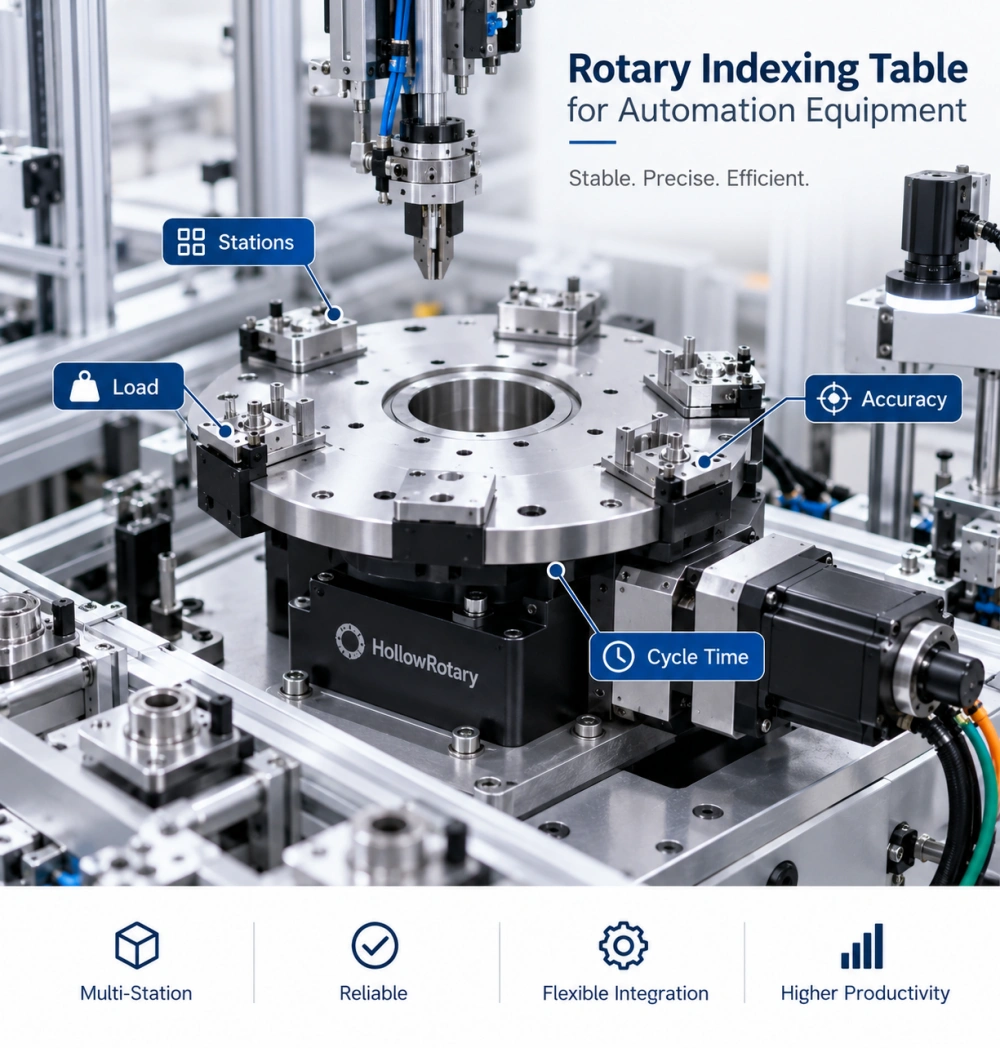
Start with the Machine Process, Not the Rotary Indexing Table
A rotary indexing table should be selected from the process requirement first. Many selection mistakes happen because buyers start with table diameter or product photos. In real automation projects, the process decides the table.
For example, an assembly machine may need four stations: loading, pressing, inspection, and unloading. A testing machine may need six fixed positions. A packaging machine may need fast indexing with moderate positioning accuracy. A vision inspection system may need slower movement but better repeatability.
These machines may all use a rotary indexing table, but the correct model and structure may be different. The station count, stop accuracy, load distribution, and duty cycle must be checked before the product is selected.
Rotary Indexing Table Station Count and Indexing Angle
Station count is one of the first points to confirm. A rotary indexing table usually moves between fixed stations. The number of stations determines the indexing angle and affects the machine layout.
| Station Count | Typical Indexing Angle | Common Use |
|---|---|---|
| 2 stations | 180° | Loading and processing, simple transfer, operator-machine separation. |
| 4 stations | 90° | Loading, assembly, inspection, unloading. |
| 6 stations | 60° | Multi-step assembly, testing, marking, sorting. |
| 8 stations or more | 45° or smaller | High-output machines with multiple working processes. |
When the number of stations increases, the fixture layout becomes more important. There must be enough space between stations for tools, sensors, grippers, cameras, and maintenance access. A compact table is useful, but the surrounding machine space must also be planned carefully.
Rotary Indexing Table Load Is More Than Weight
Load is not only the weight placed on top of the table. A rotary indexing table must also handle fixture diameter, workpiece height, center of gravity, moment load, and acceleration force during indexing.
A small and centered fixture is easier to rotate. A large plate with offset tooling is more difficult, even if the total weight does not look high. When the table starts and stops, inertia can create extra force. If the load is not balanced, the table may vibrate, settle slowly, or lose repeatability over time.
Balanced Fixture
The load center is close to the rotary center. The table can index more smoothly, and the machine is usually easier to tune.
Offset Fixture
The load center is away from the rotary center. Moment load increases, and the table needs stronger rigidity and better support.
Before selecting a rotary indexing table, prepare fixture weight, workpiece weight, table plate diameter, fixture height, and load center distance. These details are more useful than only saying “the load is not heavy.”
Cycle Time Changes the Rotary Indexing Table Selection
A rotary indexing table used once every few minutes is different from one used every few seconds. Cycle time changes the torque requirement, heat condition, stopping stability, and long-term mechanical stress.
Fast indexing is not only about motor speed. The table must accelerate, move, decelerate, stop, and settle before the next process starts. If the motion is too aggressive for the load, the machine may shake at every stop. That vibration may affect assembly tools, cameras, sensors, or measuring devices.
For this reason, buyers should provide the full motion requirement: indexing angle, movement time, stop time, cycle time, daily working hours, and whether the machine runs continuously or intermittently.
Rotary Indexing Table Accuracy: What Actually Matters?
A rotary indexing table should stop at the correct station. But the required accuracy depends on the process. A packaging orientation machine may allow more tolerance than a camera inspection system. A loading station may not need very high accuracy, while a pressing or testing station may need much better repeatability.
For multi-station machines, repeatability is often more important than a single accuracy number. If the table returns to the same position consistently, the tooling can be adjusted around that position. If the stop position changes from cycle to cycle, debugging becomes much harder.
The following points should be checked together:
- station positioning accuracy
- repeatability after many cycles
- backlash during direction change
- fixture rigidity after stopping
- settling time before the next process
Not Sure Which Indexing Structure Fits?
Share the station count, rotation angle, load, required cycle time, and process steps. We can help compare whether a rotary indexing table or servo rotary indexer is more practical for your machine.
Ask for Indexing Table SupportWhen a Servo Rotary Indexer Is a Better Choice
Some machines need fixed indexing from station to station. Other machines need programmable angles, variable stop positions, speed adjustment, or flexible process changes. In these cases, a servo rotary indexer may be more suitable than a simple fixed indexing mechanism.
A servo rotary indexer can be useful when the machine needs different angle programs, multiple product sizes, adjustable process positions, or smoother motion control. It also gives machine builders more flexibility during debugging and future upgrades.
For fixed production machines with stable station count, a rotary indexing table may be enough. For machines that need flexible indexing or programmable rotary positioning, you can also review our servo rotary indexer product page.
Rotary Indexing Table Integration Details Buyers Often Miss
The table itself is only one part of the machine. Many problems appear later because integration details were not checked early enough.
Motor Position and Machine Space
The motor direction may affect the whole machine layout. A side-mounted motor may save height but need more width. A vertical arrangement may look compact in one direction but interfere with tooling or guarding. Always check motor position before finalizing the machine frame.
Cable, Air Tube, and Sensor Routing
If the fixture carries sensors, pneumatic clamps, vacuum lines, or signal cables, routing should be planned from the beginning. A hollow rotary table or hollow rotary platform can help keep routing cleaner when center access is required.
Fixture Mounting and Maintenance
The top plate should allow reliable fixture mounting. At the same time, bolts, sensors, cables, and maintenance points should remain accessible. A compact rotary indexing table is useful only if the machine can still be assembled, adjusted, and serviced easily.
Rotary Indexing Table Selection Checklist
Before asking for a quotation, prepare the following information. This helps avoid repeated communication and reduces the chance of choosing the wrong rotary indexing table.
- Application process: assembly, inspection, testing, packaging, loading, or custom automation.
- Station count: 2, 4, 6, 8, or other station layout.
- Indexing angle: 180°, 90°, 60°, 45°, or programmable angle requirement.
- Fixture details: fixture weight, workpiece weight, plate diameter, fixture height, and center of gravity.
- Cycle time: movement time, stop time, total cycle time, and daily working hours.
- Accuracy requirement: positioning accuracy, repeatability, and whether direction changes are frequent.
- Motor requirement: servo motor, stepper motor, preferred motor brand, or motor mounting direction.
- Routing requirement: cables, air tubes, vacuum lines, or sensor wires through the center.
- Installation space: available diameter, height, motor clearance, guarding, and maintenance access.
Rotary Indexing Table vs Rotary Positioning Table
A rotary indexing table is usually selected for repeated station-to-station movement. A rotary positioning table is often selected when the machine needs more flexible angular positioning. The names may overlap in the market, but the buyer’s process requirement should decide the direction.
| Question | Better Direction |
|---|---|
| The machine always stops at the same fixed stations. | Rotary indexing table or servo rotary indexer. |
| The machine needs adjustable angles for different products. | Servo rotary table or programmable rotary positioning table. |
| The fixture needs center cable or air tube routing. | Hollow rotary table or hollow rotary platform. |
| The process needs multi-station assembly or testing. | Rotary indexing table with suitable station layout. |
Related Reading
Final Selection Advice for Rotary Indexing Tables
A rotary indexing table should be chosen according to the complete machine process. Station count, indexing angle, load, fixture layout, cycle time, accuracy, motor arrangement, and routing requirements should be reviewed together before model selection.
The best table is not always the largest or the most expensive one. It is the one that fits the real machine layout and keeps the process stable during repeated production. For automation equipment builders, a careful selection process can reduce debugging time, improve positioning consistency, and make the machine easier to maintain.
Send Your Rotary Indexing Table Requirements
Tell us your station count, fixture size, load weight, indexing angle, accuracy requirement, cycle time, motor preference, and available installation space. We will help evaluate a suitable rotary indexing solution.
Request Selection and Quote