
Rotary Positioning System for Automation: How to Match Table, Indexer, Motor and Gearbox
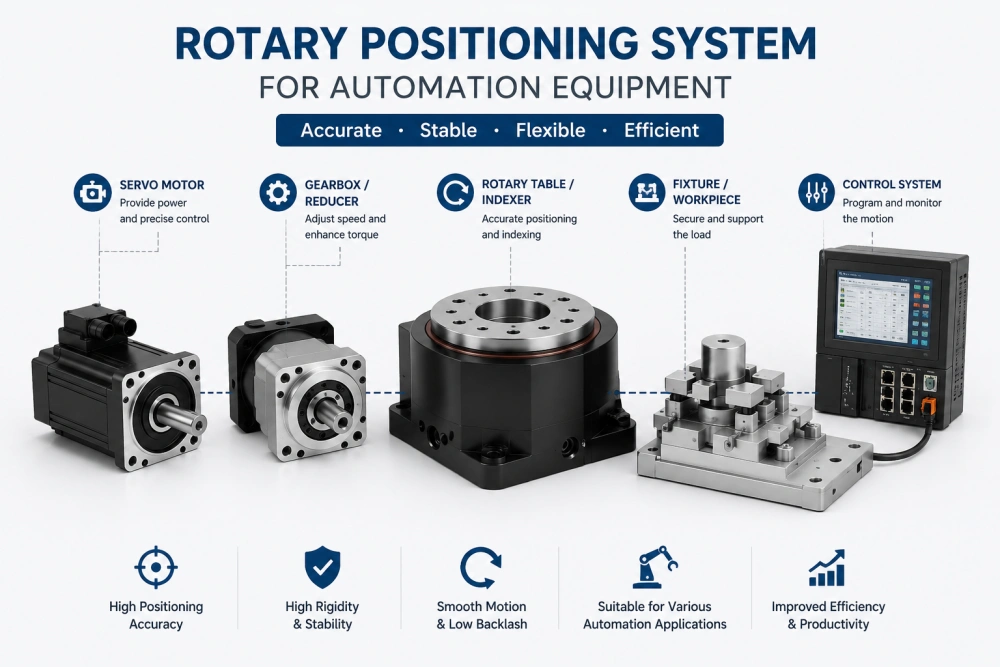
A rotary positioning system for automation is not only a single rotary table or indexer. In many machines, it is a complete motion structure that may include a rotary positioning unit, servo motor, gearbox, fixture, bearing support, and control program.
This guide explains how machine builders can match rotary tables, servo indexers, motors, and gearboxes for automated equipment without choosing a product only by name or appearance.
In packaging machinery, inspection equipment, assembly automation, electronic manufacturing, and CNC fixture positioning, rotary motion is often used to move parts to a required angle or station. The challenge is that different machines need different motion behavior. Some need flexible angle positioning. Some need repeated indexing between stations. Some need compact torque transmission. Some need a hollow center for cable or air tube routing.
Before selecting a model, buyers should first understand the machine process. A good rotary motion system should match the workpiece, fixture, speed, torque, accuracy, cycle time, and installation structure. This is why a system-level selection method is more useful than only comparing product photos.
What Is a Rotary Positioning System?
A rotary positioning system is a group of mechanical and motion-control components used to rotate, index, orient, or position a workpiece or fixture in automation equipment. It may be used as a small positioning axis, a fixture rotation module, a multi-station indexing unit, or part of a larger automated production line.
The system usually includes a rotary output structure, a motor or driving source, a transmission method, mounting interface, and sometimes a central bore or fixture table. Depending on the application, the rotary unit may be a servo rotary table, servo rotary indexer, hollow rotary table, hollow rotary actuator, or a custom motion module.
The purpose of system selection is to make sure the rotary unit can support the load, reach the target position, repeat the movement, fit the machine space, and work reliably with the control system.
Main Components in an Automation Rotary Motion Module
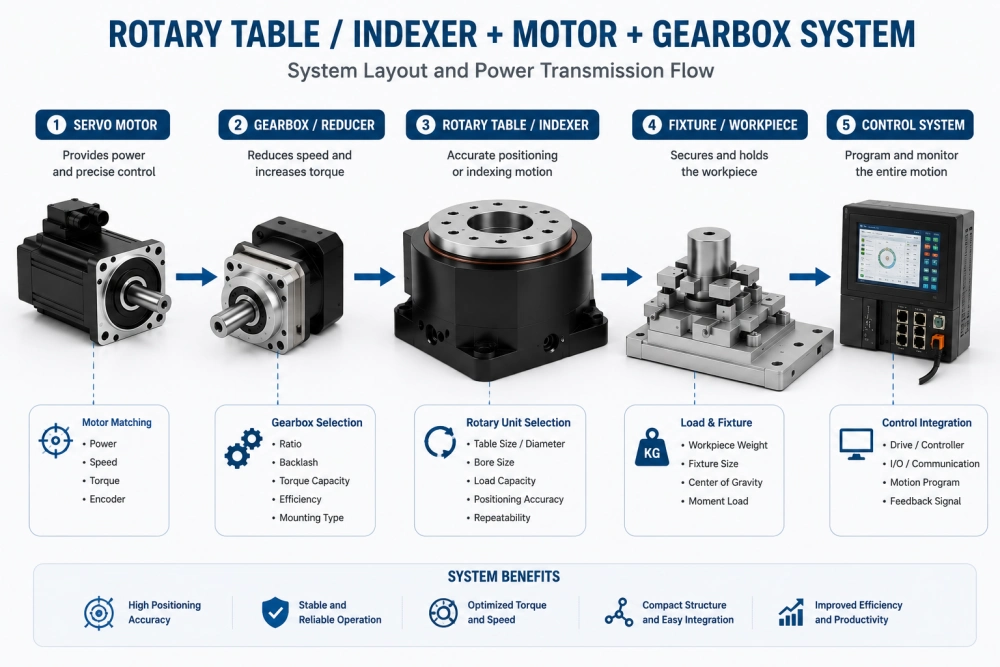
A rotary positioning system can be simple or complex. A small inspection fixture may only need a compact rotary table and servo motor. A multi-station assembly machine may need a servo indexer, fixture plate, controller, sensor feedback, and careful load calculation.
| Component | Main Function | Selection Focus |
|---|---|---|
| Rotary Table | Provides a stable rotating surface for fixtures, parts, or tooling. | Table size, load, bore size, accuracy, mounting pattern, and rigidity. |
| Servo Indexer | Moves parts or fixtures between stations in a repeated production cycle. | Station number, indexing angle, cycle time, load, repeatability, and motor matching. |
| Servo Motor | Provides controlled input motion for speed, position, and acceleration control. | Motor power, torque, encoder, drive system, control method, and installation direction. |
| Gearbox or Reduction Unit | Adjusts speed and torque between the motor and rotary output. | Ratio, backlash, torque capacity, efficiency, mounting interface, and service life. |
| Fixture and Workpiece | Defines the real load condition applied to the rotary positioning system. | Weight, diameter, height, center of gravity, offset load, and moment load. |
When to Use a Servo Rotary Table
A servo rotary table is suitable when the automation machine needs controlled rotary positioning but not necessarily a full multi-station indexing cycle. It is commonly used for fixture orientation, inspection angle adjustment, product alignment, small rotary axes, and compact machine modules.
For example, a vision inspection machine may need to rotate a component to several angles under a camera. A welding or marking machine may need to turn a fixture to a specific position. An assembly station may need to adjust the angle of a part before the next operation. In these cases, the servo rotary table works as a programmable rotary positioning axis.
When to Use a Servo Rotary Indexer
A servo rotary indexer is suitable when the machine needs repeated movement between stations. The indexer rotates a fixture plate or table from one position to another, stops for a process, and then moves to the next station.
This product direction is common in multi-station assembly machines, packaging stations, loading and unloading equipment, inspection lines, and automated transfer systems. If the process has station numbers such as 2, 4, 6, 8, or more, an indexer may be more suitable than a simple rotary positioning table.
When Is a Gearbox Needed in a Rotary Positioning System?
A gearbox may be needed when the servo motor alone cannot provide the required torque, speed reduction, or load control. In some automation machines, the rotary table or indexer already includes an internal reduction mechanism. In other systems, a separate gearbox may be used between the motor and the rotating load.
Gearbox selection depends on torque, ratio, backlash, mounting direction, efficiency, and duty cycle. A low-backlash gearbox can be useful when the machine needs accurate positioning and stable motion. A right-angle gearbox may help when installation space is limited. An inline gearbox may be more suitable when the motor and rotary axis can be arranged in the same direction.
For machine projects that also require compact torque transmission or servo motor reduction, engineers may compare related planetary gearbox solutions for automation equipment before finalizing the motion design.
The gearbox should not be selected separately from the rotary motion requirement. Motor torque, load inertia, acceleration time, positioning accuracy, and machine cycle time should be considered together.
Application Examples for Rotary Positioning Systems
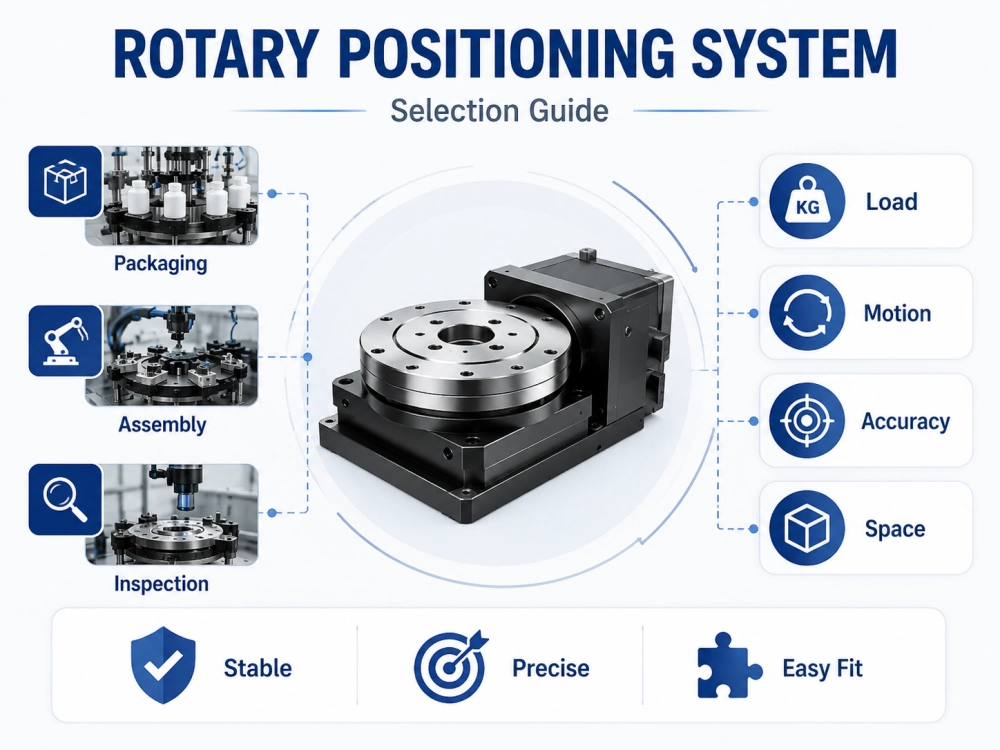
| Application | Machine Requirement | Possible System Direction |
|---|---|---|
| Vision Inspection | Rotate parts to different viewing angles for camera or sensor checking. | Servo rotary table, hollow rotary table, or compact rotary positioning module. |
| Packaging Machine | Move products through filling, capping, labeling, inspection, or sorting steps. | Servo rotary indexer or station-based rotary motion system. |
| Assembly Automation | Move fixtures between loading, assembly, fastening, testing, and unloading. | Servo indexer, rotary fixture system, or custom automation motion module. |
| CNC Fixture Positioning | Adjust the orientation of fixtures, tooling, or workpieces during machining support. | Servo rotary table or high-rigidity rotary positioning unit. |
| Electronic Manufacturing | Position small parts, connectors, sensors, PCBs, or tooling in compact equipment. | Compact rotary table, hollow rotary unit, or servo-driven positioning module. |
You can also review our automation applications page to compare different use cases before choosing a product direction.
Selection Checklist Before Quotation
A clear inquiry can reduce wrong selection and speed up quotation. Before asking for a model or price, prepare the main operating conditions of the rotary positioning system.
How to Avoid Oversizing or Wrong Matching
Oversizing a rotary positioning system may increase cost, weight, and machine space. Undersizing may cause poor stability, vibration, overload, positioning error, or shorter service life. The correct selection should balance load capacity, motion performance, accuracy, and installation convenience.
Many wrong selections happen because buyers only compare outside dimensions. However, the same table diameter can have different torque capacity, bearing support, reduction ratio, backlash, and suitable cycle time. The system should be evaluated according to the real process instead of only the product size.
If you are not sure whether your project needs a rotary table, servo indexer, hollow rotary table, or another rotary positioning product, you can send the application details before choosing the model. Our team can help evaluate the suitable product direction based on your machine layout.
Conclusion
A rotary positioning system for automation should be selected according to the machine process, not only by product name. Servo rotary tables are useful for flexible positioning and fixture orientation. Servo rotary indexers are useful for station-based indexing and repeated production cycles. Gearboxes may be needed when torque transmission, speed reduction, or motor matching requires additional support.
The best solution depends on load, fixture size, motion profile, motor selection, accuracy, cycle time, and installation space. A system-level selection method can help machine builders improve stability, reduce wrong matching, and prepare more accurate quotation information.
Need Help Matching a Rotary Positioning System?
Send us your machine function, load condition, station number, rotation angle, motor information, fixture size, accuracy requirement, and installation space. We will help evaluate whether a servo rotary table, servo rotary indexer, hollow rotary table, or custom rotary positioning solution is more suitable.
Send Your Requirement