
Hollow Bore Rotary Table for Cable Routing: Why Center Access Matters in Automation
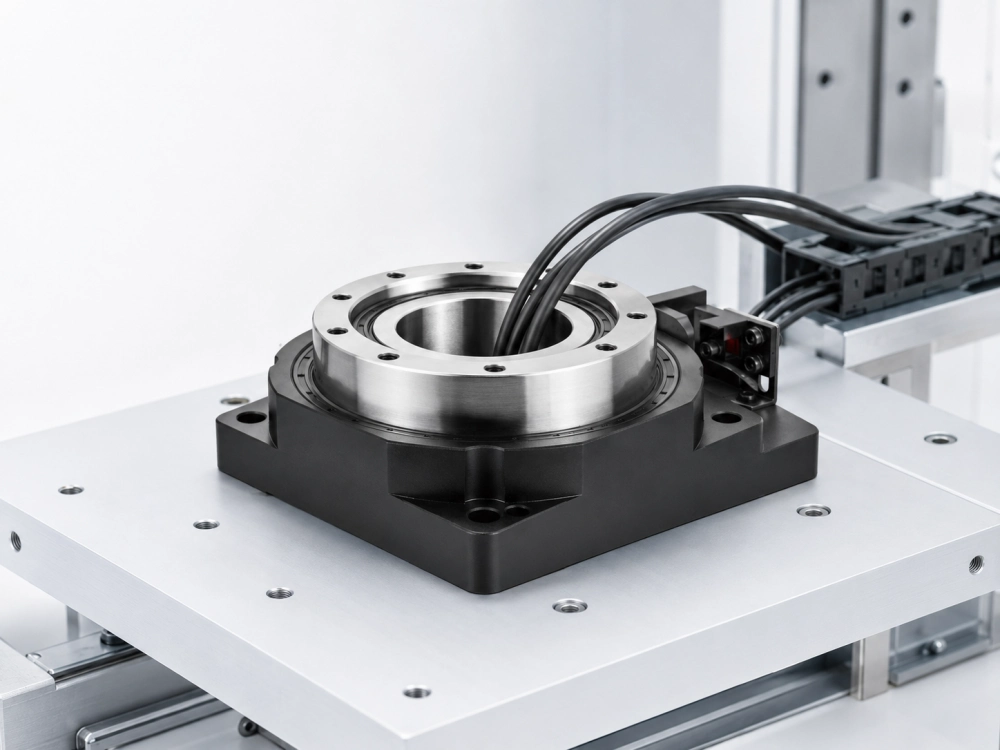
A hollow bore rotary table is often selected when automation equipment needs rotary positioning and a clean center access path at the same time. Instead of routing cables, air tubes, or vacuum lines around the outside of the rotating unit, the hollow center allows these elements to pass through the middle of the rotary structure.
This guide explains why center access matters, where hollow bore routing is useful, and what machine builders should check before choosing a rotary table for cable routing in automation equipment.
In many automation machines, rotary motion is not only about turning a fixture. The rotating part may also carry sensors, grippers, pneumatic devices, vacuum cups, inspection tools, or electrical components. These parts often need cables, air tubes, signal wires, or vacuum lines. If the routing path is not planned well, the machine may become difficult to assemble, maintain, and operate.
A hollow rotary table can help solve this problem by combining rotary positioning with a center-through structure. This makes it useful for compact automation modules, inspection systems, assembly stations, packaging machines, and custom equipment where space is limited.
What Does Hollow Bore Mean?
The hollow bore is the center opening inside the rotary table or rotary positioning unit. This opening allows machine elements to pass through the middle of the rotating axis. Depending on the application, the center bore may be used for electrical cables, pneumatic tubes, vacuum lines, sensor wiring, optical paths, or a mechanical shaft.
In a normal solid rotary structure, these items usually need to be routed around the outside. That may create longer cable paths, exposed hoses, moving loops, or interference with surrounding machine parts. A hollow bore design gives engineers another routing option and can make the equipment layout cleaner.
The hollow bore does not mean every project can pass unlimited cables through the center. The available bore size, bending radius, tube diameter, cable movement, and fixture design still need to be checked.
Why Center Access Matters in Automation Equipment
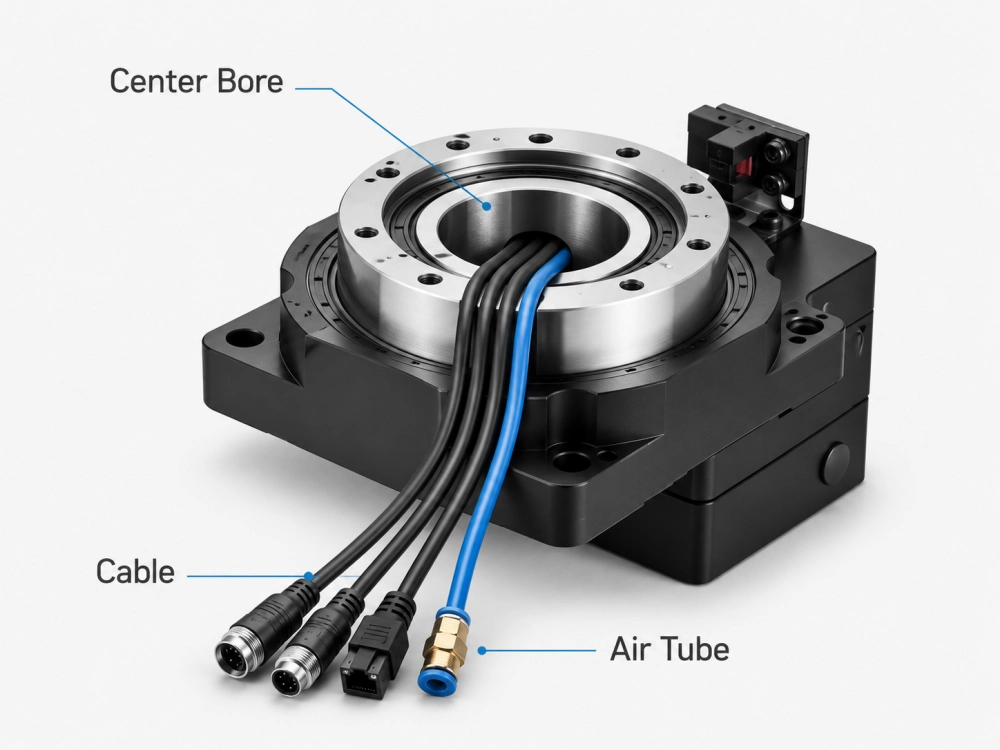
Center access is important because many automation machines are becoming more compact. Engineers often need to place motors, sensors, fixtures, cylinders, cameras, and tooling into limited space. If cables and tubes are routed outside the rotary unit, they may interfere with nearby guards, frames, conveyors, robots, or other moving parts.
A hollow bore rotary table can simplify the design by keeping the routing path closer to the rotary center. This can reduce the risk of dragging, twisting, collision, or accidental contact during machine operation.
| Routing Need | Why Center Bore Helps | Typical Application |
|---|---|---|
| Sensor wiring | Allows signal wires to pass through the middle instead of around the outside. | Inspection table, assembly fixture, testing station. |
| Air tubes | Helps connect pneumatic clamps, grippers, or small cylinders on rotating fixtures. | Assembly automation, loading fixture, packaging station. |
| Vacuum lines | Supports suction cups or vacuum holding devices mounted on the rotating plate. | Pick-and-place, part holding, electronic manufacturing. |
| Optical path | Can provide a central opening for light, camera, or inspection-related equipment. | Vision inspection, optical alignment, measurement module. |
Common Problems with External Cable Routing
External routing is not always wrong. In simple equipment, it may be acceptable and easy to maintain. However, when the rotary station moves frequently or the machine space is tight, external routing can create practical problems.
These problems are especially common in compact fixtures, multi-function inspection stations, electronic assembly equipment, and automated machines with many small devices installed near the rotating axis.
Where Hollow Bore Cable Routing Is Useful
A hollow bore rotary table is useful when the machine needs both rotary positioning and a center-through path. The center bore can support cleaner routing and help reduce design complexity around the rotating station.
You can also review more automation application examples to compare where rotary positioning products are commonly used.
Hollow Bore Rotary Table vs Other Rotary Options
Not every rotary positioning project requires a hollow bore. If the fixture is simple and there are no cables, tubes, or center-access requirements, a standard rotary table or servo positioning unit may be enough. If the machine needs step-by-step movement between stations, a servo rotary indexer may be more suitable.
If the project requires a compact integrated rotary drive with center access, a hollow rotary actuator can also be considered. The best direction depends on the actual machine layout, load condition, and routing requirement.
| Product Direction | Better When | Main Selection Point |
|---|---|---|
| Hollow Rotary Table | The machine needs stable table support and center routing. | Bore size, table size, load, accuracy, fixture mounting. |
| Servo Rotary Table | The machine needs flexible angular positioning. | Angle control, speed, load, repeatability, motor matching. |
| Servo Rotary Indexer | The machine needs repeated station-to-station movement. | Station number, indexing angle, cycle time, fixture load. |
| Hollow Rotary Actuator | The machine needs compact rotary drive and center access in one unit. | Motor layout, bore size, torque, installation space. |
What to Check Before Choosing a Hollow Bore Rotary Table
Before selecting a model, the most important point is to describe what needs to pass through the center. Cable routing and tube routing are not only about bore diameter. The routing path, bending space, movement range, connector size, and maintenance access also matter.
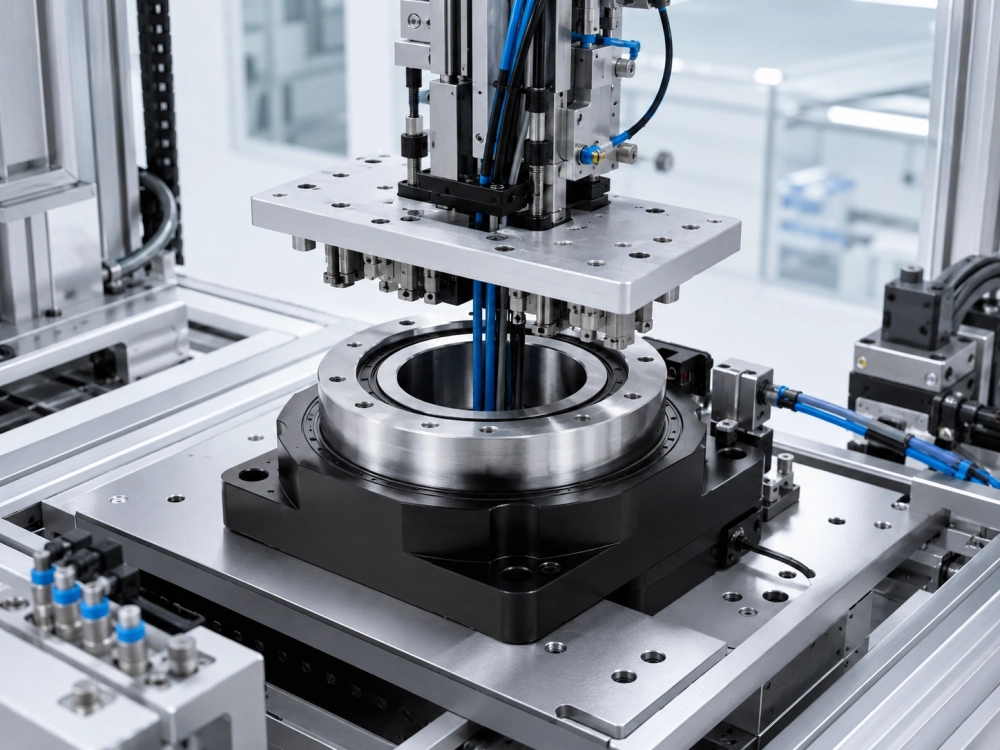
Selection Checklist for Buyers
A clear inquiry helps the supplier recommend a suitable model faster. If your project needs center bore routing, include routing information together with normal motion and load information.
| Information to Provide | Example Detail |
|---|---|
| Application type | Inspection station, packaging machine, assembly fixture, testing device, or custom automation. |
| Routing requirement | Cables, air tubes, vacuum lines, optical path, mechanical shaft, or mixed routing. |
| Bore requirement | Required inside diameter, connector size, number of lines, and bending space. |
| Load condition | Fixture weight, workpiece weight, table diameter, height, and offset load. |
| Motion requirement | Rotation angle, speed, cycle time, dwell time, accuracy, and repeatability. |
| Motor and installation | Servo motor preference, mounting direction, machine space, and control requirement. |
Conclusion
A hollow bore rotary table is valuable when automation equipment needs rotary positioning and a clean center routing path. It can help route cables, air tubes, vacuum lines, or sensor wires through the center of the rotary station, making the machine layout more compact and organized.
The right selection depends on bore size, routing path, load condition, fixture design, rotation angle, accuracy requirement, and installation space. Instead of choosing only by outside size, buyers should describe how the rotary table will be used inside the machine.
Need Help Selecting a Hollow Bore Rotary Table?
Send us your application type, routing requirement, bore size, load condition, fixture size, rotation angle, motor information, and installation space. We will help evaluate whether a hollow rotary table, servo rotary table, servo rotary indexer, or hollow rotary actuator is more suitable.
Send Your Requirement