
How to Select a Gearbox for Rotary Positioning Systems
Rotary positioning systems are essential components in modern automation equipment. They are widely used in assembly machines, inspection systems, packaging equipment, robotics, and precision manufacturing applications where controlled rotation and accurate positioning are required.
However, a rotary positioning mechanism alone is not enough to achieve reliable motion performance. The complete system usually includes a rotary table, rotary actuator, servo motor, gearbox, controller, and mechanical fixture. Among these components, gearbox selection plays an important role in determining torque capability, positioning accuracy, speed performance, and long-term reliability.
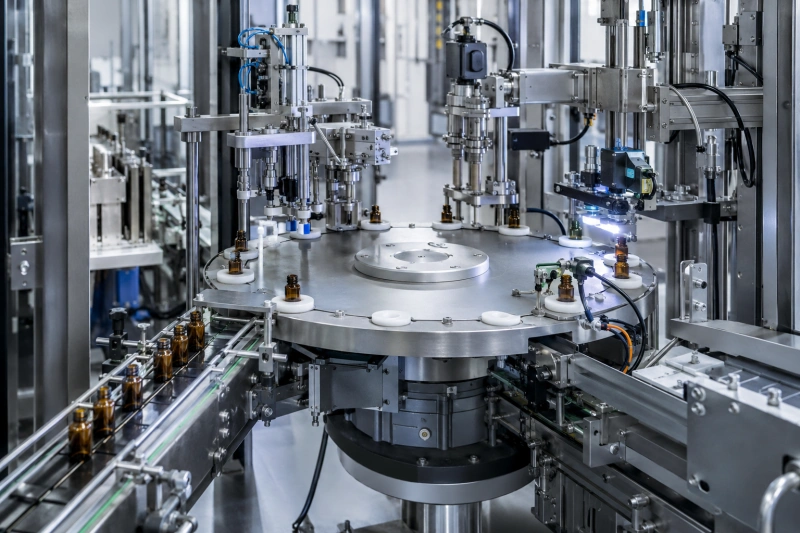
Why Gearbox Selection Matters in Rotary Positioning Systems
A gearbox transfers the motor output into suitable speed and torque for the rotary mechanism. In many automation applications, servo motors provide high-speed rotation but cannot directly deliver the required torque or control characteristics for heavy fixtures and workpieces.
A properly selected gearbox helps match the motor performance with the actual machine requirements. It allows the rotary positioning system to operate smoothly while maintaining accurate positioning during repeated production cycles.
For machine builders, gearbox selection usually depends on several key factors:
- Required output torque and load capacity
- Reduction ratio and operating speed
- Positioning accuracy and backlash requirements
- Servo motor compatibility
- Installation space and mechanical layout
- Continuous working cycle requirements
Understanding the Relationship Between Servo Motor and Gearbox
The servo motor provides controlled rotation, while the gearbox improves the mechanical output characteristics. Together, they create a more suitable drive system for rotary positioning applications.
For example, a high-speed servo motor may rotate thousands of revolutions per minute. However, a rotary table used for inspection or assembly may require slower but more powerful and precise movement. The gearbox reduces speed while increasing available torque at the output side.
This combination allows automation equipment to achieve:
- Higher output torque for larger fixtures
- Better control of acceleration and deceleration
- Improved positioning stability
- More compact machine design
Key Factors for Choosing a Gearbox for Rotary Positioning
1. Torque and Load Matching
The first consideration is the actual mechanical load. Engineers should evaluate fixture weight, workpiece mass, offset distance, and rotation speed before selecting a gearbox.
If the gearbox capacity is too small, the system may experience unstable movement, reduced accuracy, or shortened service life. A suitable gearbox provides enough torque margin for reliable operation.
2. Backlash and Positioning Accuracy
Precision automation equipment often requires repeatable positioning. Backlash inside the transmission system may influence the final accuracy of the rotary mechanism.
Applications such as vision inspection, electronic assembly, and robotic positioning normally require low backlash transmission solutions to maintain consistent positioning performance.
3. Speed and Reduction Ratio
Different automation machines require different motion characteristics. High-speed indexing applications may require lower reduction ratios, while heavy-duty positioning systems may require higher reduction ratios for increased torque.
Choosing the correct ratio helps balance speed, torque, and motor efficiency.
Planetary Gearbox for Rotary Automation Applications
Planetary gearboxes are widely used in industrial automation because of their compact structure, high torque density, and excellent transmission efficiency.
Compared with conventional transmission methods, planetary gearboxes provide several advantages:
- Compact installation size
- High torque output
- Good mechanical efficiency
- Suitable for servo motor applications
- Stable operation under repeated cycles
When a rotary positioning system requires precise motion control together with strong torque output, a suitable planetary gearbox solution can improve overall system performance.
Inline or Right Angle Gearbox: Which Layout Is Better?
The mechanical layout of the machine also affects gearbox selection.
Inline Planetary Gearbox
Inline gearboxes are commonly selected when the motor and rotary axis share the same direction. They provide a compact and efficient transmission path suitable for many automation machines.
Right Angle Planetary Gearbox
Right angle gearboxes are useful when installation space is limited or when the motor direction needs to be changed. They can help machine designers create more compact equipment layouts.
For applications requiring a 90-degree transmission arrangement, right angle planetary gearbox solutions may provide a suitable option.
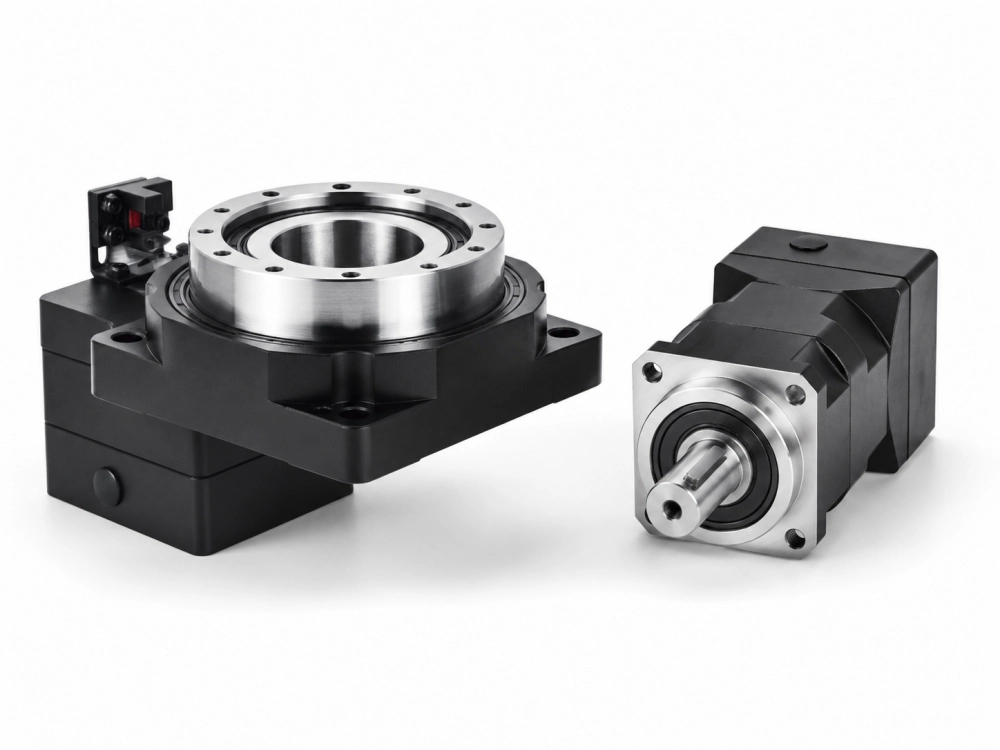
Gearbox Integration with Rotary Tables and Indexers
A gearbox should not be selected separately from the rotary positioning mechanism. The complete motion system needs to be considered as one integrated solution.
Important integration points include:
- Rotary table size and fixture weight
- Servo motor specification
- Output torque requirement
- Required positioning accuracy
- Machine installation space
- Working environment conditions
For example, a packaging machine may require fast repeated indexing, while a precision inspection machine may prioritize smooth and accurate positioning. The gearbox configuration should match the actual application requirements.
Applications Using Gearbox-Based Rotary Positioning Systems
Assembly Automation
Rotary positioning systems combined with servo motors and gearboxes are widely used in assembly stations. They help rotate fixtures between different production steps such as fastening, pressing, dispensing, and testing.
Inspection Equipment
Vision inspection machines require stable and repeatable rotation. A properly matched gearbox helps maintain smooth movement during multi-angle inspection processes.
Packaging Machinery
Packaging systems often operate continuously with repeated indexing cycles. Reliable gearbox performance helps maintain production speed and positioning consistency.
Robotic Automation
Robotic workstations use rotary positioning modules to orient components before processing, assembly, or inspection. Compact gearbox solutions help improve machine flexibility.
How to Improve Rotary System Reliability
Besides gearbox selection, several mechanical factors influence the reliability of rotary positioning systems. Proper fixture balance, rigid mounting, correct motor matching, and suitable operating conditions all contribute to better performance.
Working with an experienced motion component supplier during the early design stage can help engineers avoid incorrect component selection and reduce development time.
Frequently Asked Questions
Do all rotary positioning systems need a gearbox?
Not every system requires a gearbox. The choice depends on torque requirements, speed, accuracy, and machine structure.
Why use a planetary gearbox with a servo motor?
A planetary gearbox improves torque output and provides better mechanical matching between the servo motor and rotary mechanism.
How do I choose the correct gearbox size?
Engineers should consider load, speed, inertia, accuracy requirements, mounting space, and working cycle before selection.
Conclusion
Selecting the correct gearbox for a rotary positioning system is an important step in designing reliable automation equipment.
By properly matching the servo motor, gearbox, and rotary mechanism, machine builders can achieve improved torque performance, smoother motion, and more stable positioning accuracy.
Need Help Selecting a Rotary Motion Solution?
Share your application requirements including load, speed, accuracy, motor information, and machine layout. Our engineering team can help recommend a suitable rotary positioning solution.
Request Engineering Support