
Hollow Rotary Table Accuracy Guide for Automation Equipment
A hollow rotary table is often selected when automation equipment needs accurate rotary positioning, compact structure, stable fixture support, and center bore access for cables, air tubes, vacuum lines, or sensor wiring. But choosing the right model is not only about table diameter or bore size. Real accuracy depends on how the rotary table performs under load, during repeated cycles, and inside the complete machine structure.
For machine builders, hollow rotary table accuracy should be evaluated together with repeatability, backlash, runout, rigidity, moment load, fixture design, servo motor matching, gearbox layout, and installation quality. A catalog number can be useful, but it does not always show how the table will behave after a real fixture, workpiece, motor, and cable routing system are installed.
This guide explains how to evaluate hollow rotary table accuracy in automation equipment, what technical points buyers should check, and how to avoid common selection mistakes before ordering a rotary positioning solution.
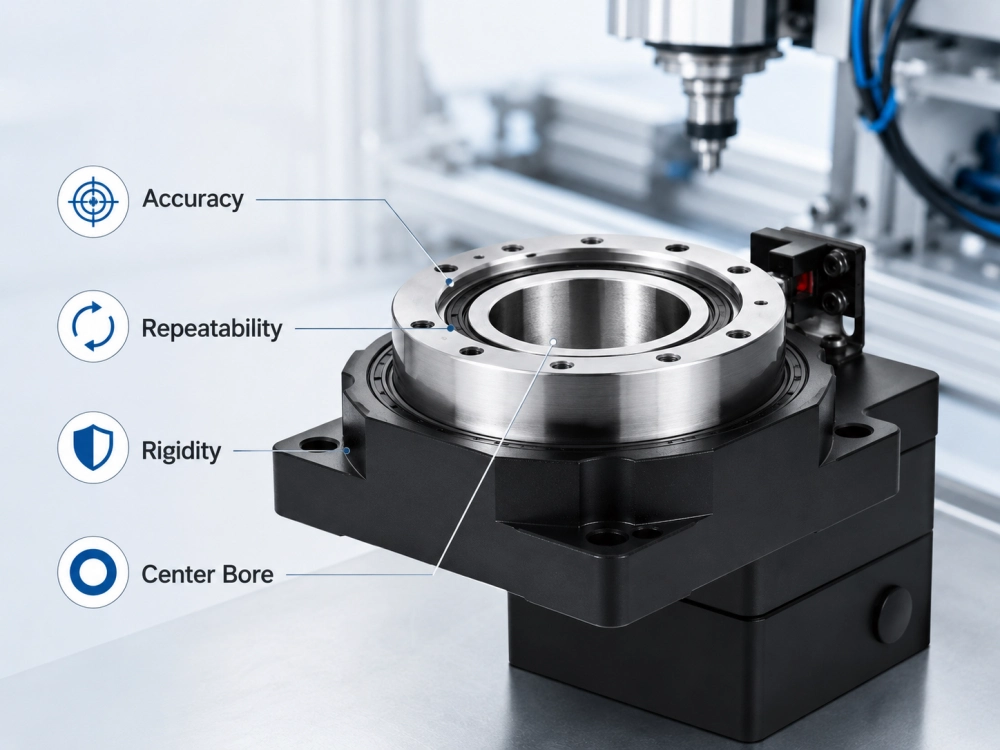
What Does Hollow Rotary Table Accuracy Mean?
Hollow rotary table accuracy describes how closely the output table reaches the commanded angular position. If the controller commands the table to stop at 90 degrees, accuracy describes how close the real stop position is to that target.
In a simple rotating device, small angular errors may not matter. In automation equipment, however, a small deviation can affect camera inspection, assembly alignment, testing contact, laser marking position, robot loading, or packaging orientation. This is why a hollow rotary table should be evaluated as a positioning component, not only as a rotating platform.
The hollow structure adds another practical requirement. The center bore is useful because cables, air tubes, or vacuum lines can pass through the middle of the table. This can make the machine cleaner and easier to maintain. At the same time, the table must still provide enough rigidity and load support around the hollow center. Good design should balance center access, accuracy, load capacity, and compact installation.
Accuracy and Repeatability Are Not the Same
Many buyers ask for “high accuracy,” but the real requirement may be repeatability. These two terms are related, but they do not mean the same thing.
Accuracy describes how close the actual stop position is to the target position. If the table is commanded to stop at 180 degrees, accuracy tells you how close the final output position is to 180 degrees.
Repeatability describes how consistently the table returns to the same position after repeated movements. In many automation machines, repeatability can be more important than absolute accuracy. A fixed offset can sometimes be calibrated during setup, but unstable repeated positioning is much harder to correct.
For example, if a table stops at 90.02 degrees every cycle, the machine may be adjusted around that small fixed offset. But if it stops at 89.96 degrees, 90.04 degrees, and 90.01 degrees across different cycles, the process becomes less predictable. For inspection, assembly, or testing equipment, unstable repeatability can become a real production problem.
Why Accuracy Matters in Hollow Rotary Systems
A hollow rotary table is often installed at the center of an automation process. A fixture may be mounted on top. A product may be loaded onto the fixture. The table may rotate between loading, inspection, assembly, testing, and unloading positions. If the rotary position is unstable, every station after that can be affected.
In vision inspection, poor positioning can shift the product under the camera. In assembly equipment, angular error can cause a part to miss the tool center. In robotic workstations, the robot may need extra correction because the part is not presented in the same position each time. In testing equipment, inconsistent table position can affect measurement results.
This is why hollow rotary table accuracy should be reviewed at the system level. The table, fixture, servo motor, transmission layout, mounting plate, and machine frame all influence the final result.
Key Factors That Affect Hollow Rotary Table Accuracy
1. Internal Mechanical Structure
The internal structure of a hollow rotary table has a direct effect on accuracy. A stable transmission mechanism helps reduce lost motion and improves positioning consistency. The output table should also be rigid enough to support the fixture without unwanted movement.
Because the table has a center bore, the mechanical structure must provide both open-center access and strong support around the rotating platform. A larger bore may help with cable routing, but the table still needs enough rigidity to handle load, moment force, and repeated acceleration.
2. Backlash and Lost Motion
Backlash is the small clearance inside the mechanical transmission chain. When the direction of rotation changes, the input may move slightly before the output table responds. This creates lost motion and can reduce rotary positioning accuracy.
Backlash becomes more important when the machine requires forward and reverse movement, short angle correction, or repeated stops at different positions. A low-backlash hollow rotary table can help make the output motion more predictable and easier to control.
3. Runout and Surface Stability
Runout refers to unwanted movement during rotation. It may appear as radial runout, axial runout, or surface wobble. In real applications, runout can affect the position of the fixture or workpiece mounted on the table.
For example, in a camera inspection system, excessive runout may change the part height or center position under the camera. In an assembly machine, it may affect how well the part aligns with a screwdriver, press head, sensor, or robot gripper. For this reason, buyers should not evaluate only angular accuracy. Surface stability also matters.
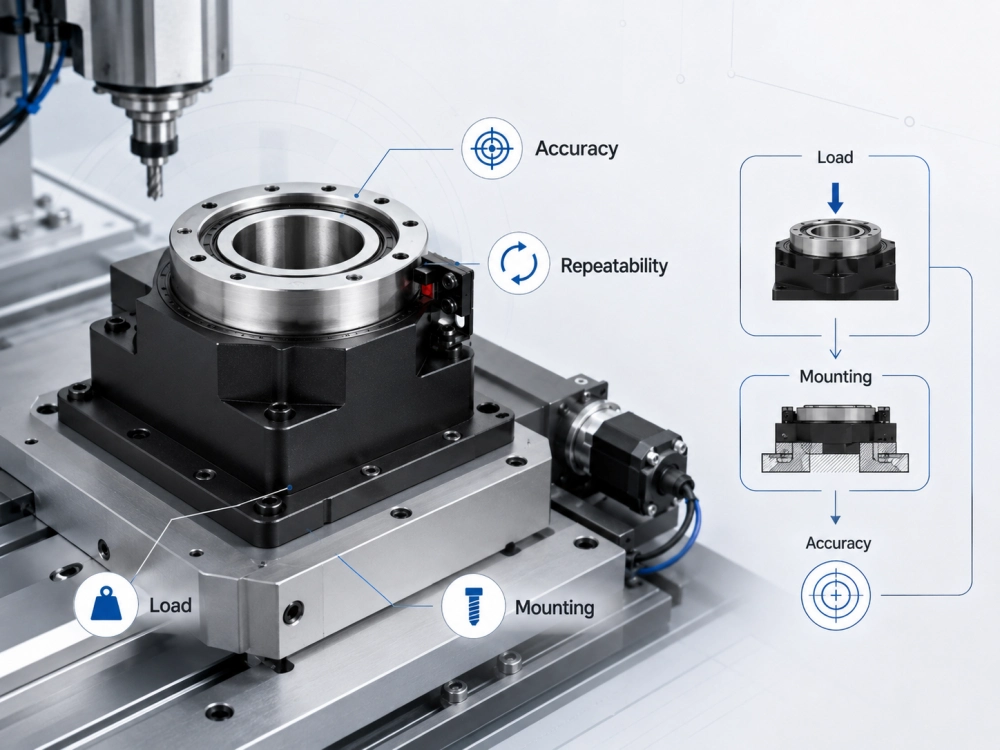
4. Rigidity and Moment Load
A hollow rotary table may show good performance under light load, but the result can change after a real fixture is installed. Fixture weight, workpiece weight, load center distance, and external process force can all influence positioning stability.
Moment load occurs when the load center is away from the rotary table center. This often happens when the fixture extends outward, when the product is not balanced, or when the process includes pressing, testing, clamping, or side force.
If the table does not have enough rigidity, the fixture may tilt slightly during movement or stopping. Even a small deflection can affect inspection quality, assembly alignment, or test repeatability. Before choosing a model, buyers should review axial load, radial load, moment load, and fixture structure together.
5. Servo Motor and Gearbox Layout
Servo control is important, but it cannot fully correct poor mechanical structure. A servo motor can improve speed control, acceleration, deceleration, and position command response. However, the final hollow rotary table accuracy still depends on the complete mechanical chain.
Some rotary positioning systems connect the servo motor directly to the table. Other systems use a gearbox to improve torque output, match inertia, or fit the motor into a limited machine space. When the machine requires a compact side-mounted motor arrangement, a right angle planetary gearbox can be considered as part of the transmission layout. When the motor can be installed in the same direction as the input axis, an inline planetary gearbox may be more suitable for a straight-axis arrangement.
The point is not to choose a gearbox first. The better approach is to check the whole motion chain: servo motor, gearbox if required, coupling, table structure, fixture load, and installation rigidity.
Application Examples Where Accuracy Matters
Vision Inspection Equipment
Vision inspection machines often use a hollow rotary table to rotate parts under cameras, lights, and sensors. If the table stops at slightly different angles, the image position may shift. This can affect defect detection, dimension checking, barcode reading, and alignment measurement.
Automated Assembly Machines
In assembly equipment, the table may move a fixture between loading, pressing, fastening, inspection, and unloading stations. Stable rotary positioning helps reduce part misalignment and keeps the process consistent across production cycles.
Electronic Manufacturing Equipment
Electronic manufacturing often requires compact structure, accurate positioning, and clean wiring. A hollow rotary table can help route cables or air tubes through the center bore while supporting fixture rotation in a limited machine space.
Robotic Workstations
Robots often use rotary tables as auxiliary positioning axes. A stable table can present the workpiece at a predictable angle, helping improve robot pickup accuracy, inspection position, and assembly consistency.
Testing and Measurement Equipment
Testing equipment may rotate a product to several defined angles. If the table position varies from cycle to cycle, the test result may become inconsistent. Accurate and repeatable rotary positioning helps create more stable testing conditions.
How to Evaluate a Hollow Rotary Table Before Selection
Before selecting a hollow rotary table, buyers should prepare real application data instead of choosing only by outside diameter. A supplier needs to understand the load, fixture, motion profile, motor information, and accuracy requirement before recommending a suitable model.
- Required positioning accuracy: target angle and acceptable angular error.
- Repeatability requirement: how consistently the table must return to the same position.
- Load condition: fixture weight, workpiece weight, load center distance, and installation direction.
- Runout requirement: radial runout, axial runout, or surface stability requirement.
- Motion profile: rotation angle, stop positions, speed, acceleration time, stopping time, and cycle time.
- Motor information: servo motor brand, power, frame size, shaft size, and mounting direction.
- Center bore requirement: cable quantity, air tube size, vacuum line, sensor wiring, and routing space.
- Application type: inspection, assembly, robotics, testing, packaging, or electronic manufacturing.
For compact automation equipment, a hollow rotary table can provide accurate rotary positioning while supporting center bore routing. For programmable servo-driven movement, the servo rotary table page may be useful. For multi-station indexing applications, you can also review our servo rotary indexer options.
Common Mistakes When Comparing Accuracy
One common mistake is comparing catalog accuracy without checking the real load condition. A table may perform well without load, but the result can change after a heavy or offset fixture is mounted.
Another mistake is ignoring repeatability. A machine can sometimes compensate for a fixed position offset, but unstable repeat positioning is much harder to solve.
A third mistake is relying only on servo tuning. Servo control can improve motion behavior, but it cannot remove poor rigidity, backlash, loose mounting, fixture deflection, or weak bearing support.
A fourth mistake is choosing a table only by outside diameter. A better selection should consider accuracy, repeatability, backlash, runout, bore size, moment load, motor matching, cable routing, installation direction, and application conditions.
Selection Checklist
| Selection Item | Why It Matters |
|---|---|
| Positioning Accuracy | Determines how close the hollow rotary table stops to the commanded angle. |
| Repeatability | Shows whether the table can return to the same position consistently. |
| Backlash | Affects direction changes, short correction movements, and output response. |
| Runout | Influences surface stability and workpiece position during rotation. |
| Rigidity | Helps reduce deflection, vibration, and unstable positioning under load. |
| Center Bore | Supports cable, air tube, vacuum line, or sensor wire routing through the table center. |
| Motor Matching | Improves acceleration, stopping behavior, and complete system stability. |
FAQ
What is hollow rotary table accuracy?
Hollow rotary table accuracy describes how close the output table stops to the commanded angle. It is affected by repeatability, backlash, runout, rigidity, load, fixture design, motor matching, and installation quality.
Is repeatability more important than accuracy?
It depends on the machine process. In many automation systems, repeatability is very important because the table must return to the same position consistently during repeated production cycles.
Can servo control improve hollow rotary table accuracy?
Servo control can improve motion behavior, but mechanical accuracy still depends on the table structure, bearing support, backlash, rigidity, fixture design, and transmission layout.
When should I choose a hollow rotary table?
A hollow rotary table is suitable when the machine needs accurate rotary positioning, compact structure, stable fixture support, and center bore access for cables, air tubes, vacuum lines, or sensor wiring.
Conclusion
A hollow rotary table should not be selected by bore size or table diameter alone. Real performance depends on accuracy, repeatability, backlash, runout, rigidity, load condition, fixture design, servo motor matching, gearbox layout, and installation quality.
For machine builders, the best choice is the model that matches the real load, motion pattern, accuracy requirement, installation space, motor layout, center bore routing, and long-term production condition. By evaluating the complete rotary positioning system, buyers can reduce selection mistakes and improve machine stability.
Reference Notes
- Hollow rotary table accuracy should be evaluated together with repeatability, backlash, runout, rigidity, load, and bore size.
- Fixture weight, center of gravity, and moment load can strongly affect real positioning performance.
- Servo control is useful, but it cannot replace mechanical precision in the table and transmission chain.
- Gearbox layout should be considered only when the rotary system requires specific motor mounting, torque matching, or space optimization.
Need Help Selecting a Hollow Rotary Table?
Share your load, fixture size, required accuracy, repeatability, speed, cycle time, motor information, bore size requirement, installation direction, and machine layout. HollowRotary can help evaluate whether a hollow rotary table, servo rotary table, servo rotary indexer, or other rotary positioning solution is more suitable for your automation equipment.